

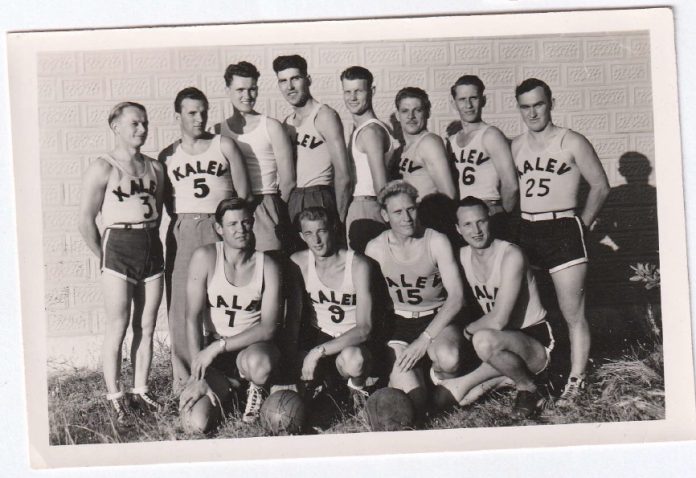
Recently, the return of a 1944 presidential flag from Australia sparked curiosity as to its journey through history. Naturally, that was inextricably linked to its custodian, Eugen Vilder, and it was reported that the flag was unfurled when Kalev basketball team formed in Perth, his brother, Voldomar, being an inaugural member.
That raises a whole other story… how a bunch of displaced persons in Perth — 13,000 km from their Estonian homeland — came to form a team named after a mythical giant to play a sport born in Canada!
When the first Estonians arrived in Fremantle post-World War II, they did not just bring Estonian traditions with them, but newly acquired skills developed and honed in the Displaced Persons camps in Germany (mostly). These camps were run by the “west”, the US, England and France, and each had their own dynamic.
Some had high schools and when class finished at 1pm, students gathered in the former barracks hall, repurposed as a sport stadium, and played basketball, volleyball and table tennis. Why? Because minimal equipment was required and those sports could be played indoors.
Basketball was not new to Estonia. With independence in 1918, global influences were welcomed and basketball was one that took hold. So much so that Estonia was one of only 21 countries that competed in basketball at the 1936 Berlin Olympic Games. The sport was familiar to European and US armed forces as well and worked well in the confines of military barracks where Displaced Persons were held. As nationalities were segregated in the camps, there was no Displaced Persons basketball world cup happening, just each nationality playing amongst themselves.
The majority of Estonians in the German camps were not necessarily good at basketball (underarm, two-handed shots were common) — but they at least had exposure. Accordingly, when they landed in Fremantle, it was logical that they continued to play — sport helps to bring communities together and many had been playing for at least 5 years by then.
Australians, on the other hand, were new to basketball. The sport could at best be described as nascent, with far greater participation in British sports (rugby, cricket, soccer) and the domestically developed Aussie Rules football. But in 1946, a local basketball competition was established in Perth, mostly comprising returned servicemen that learned the game in the armed forces. Before too long, those fresh off the Freo wharf were keen to get involved. But interestingly, not the many Italians, Greeks, Ukrainians, Polish, Serbians, Croatians, etc. — they formed soccer clubs. It was the “Balts” that found basketball.
The Latvians (Patria) and Lithuanians (Storm) joined the A grade competition in 1950, playing each other in the Grand Final in their first year. Estonia’s Kalev joined in 1951.
The Balts, as a collective, were roundly admired for their athleticism and ability, dominating the league during the early 1950s, and have been credited with raising the standard of basketball in Western Australia. They became the “glamour” teams of the competition, drawing in new participants and spectators — and reportedly invoking some jealousy from the locals!
Compared to modern basketball, playing for Kalev was rudimentary stuff. Training occurred wherever they could find an outdoor bitumen court (Bayswater Tennis Club was one location) and there were no changerooms or any other amenities. Games were played on Friday evenings in the Centenary Pavilion at the Claremont Showgrounds — basically a large shed which was inordinately cold in winter. Some of the players had to rush from their workplaces over 100 km away to play. Nonetheless, it provided newly arrived Estonian men a community, where they could shout in their language, share customs from another world away and develop self-confidence, through team and individual success, in their new homeland.
All three of the Baltic basketball teams did not survive the 1950s. Individuals moved interstate and within Western Australia for work, married and shifted priorities — along with trying their hand at different sports that came with Australian life, from spearfishing to tennis. Those that kept playing basketball, joined non-ethnic teams like the YMCA or Highgate. It is believed Kalev basketball was wound up in 1956 (though a Kalev volleyball team continued).
Although Kalev never won the premiership in its time, individual players were recognised. In 1955, the A Grade Fairest and Best was awarded to Viido Narustrang, winning the inaugural Cleve Wright Medal, and both Erik Holm (1957) and Viido (1958—62) winged their way east to represent Western Australia in the national sphere.
Western Australia is widely regarded as a strong basketball state, with a long, rich history and sustained success (the Perth Wildcats holds the world record of any professional sporting team for consecutive finals appearances — an incredible 35 — along with the most championship rings). It is not a stretch to say that Kalev played a small, but important part in building this legacy. As they say, mighty trees grow from tiny seeds.
Sources
The Formative Years published by Basketball Western Australia
Viido Narustrang

