

I’ve had the privilege of growing up in two Estonias — one that was occupied, and one that is free.
When I was a child, freedom was spoken about at the dinner table like it was a long-awaited VIP guest…who was running very, very late.
“One day soon,” my parents would say.
“Never lose hope.”
And I would occasionally look toward the front door while eating my potatoes, thinking…
Is he coming yet?
What does he look like?
Does he knock? Or does he just walk in and rearrange the furniture?
What does freedom look like to you? Have you ever thought about this?
Because here’s the truth — it’s not entirely accurate to say we had no freedoms back then. We had some freedoms… within boundaries so carefully measured they could have been drawn with a ruler.
We learned early:
Don’t say that.
Not here.
Not to them.
Maybe to her — she’s safe.
We all learned how to read a room before we learned two plus two. We developed survival instincts so refined they would impress modern intelligence agencies. And yes — we found freedom anyway. In the small spaces between the rules.
For me, as a child, freedom looked like summer.
It looked like racing my friends across sandy beaches.
It looked like running through forests with blueberry-stained fingers.
It looked like stuffing wild strawberries into my mouth faster than anyone else could.
The forests were ours. The lakes were ours. The sea was ours. Here my thoughts were my own.
Freedom also looked like Pirita beach in Tallinn, soaked in suntan oil because, apparently, the sun in Estonia only shone — it didn’t burn — and everyone was after that perfect tan. In Melbourne, I now avoid the midday sun like a sensible immigrant who has learned her lesson. Multiple times.
But here’s what I’ve learned as an adult: freedom is deeply personal. We ache for it when it’s taken. And we risk taking it for granted once we have it.
Estonia has been free again since 1991. 35 years. That’s a whole generation who have never felt that flash of fear before speaking their mind. Never had to quickly scan the room before saying something honest.
And it is also 108 years since independence was first declared.
That is not luck. That is not coincidence. That took the courage of many, persistence and a national refusal to be erased.
Today we can criticise governments. We can disagree publicly. We can vote. We can leave and return.
We can build lives across oceans and still argue passionately about how to make the rukkileib or kringel just right.
But freedom is not automatic. And history has a way of reminding us how fragile freedom can be.
Those of us who lived through Melbourne’s lockdowns know that restrictions on freedom are not merely things that happen somewhere else, or sometime in history. We lived with curfews, five-kilometre limits, closed borders and restrictions on where we could go and who we could see.
I remember not being able to travel to say goodbye to my dad when he passed away. That feeling of being physically prevented from crossing a border to get back to Estonia — stirred something ancient in me. The circumstances were different. But that loss of choice felt strangely familiar.
Freedom is not abstract. It is physical. It is emotional. It is human. And the cages that limit it come in many shapes.
Sometimes they are political systems.
Sometimes emergencies.
Sometimes the fear we feel in our bones.
And sometimes — if we’re honest — they are convenience and comfort.
Because it is surprisingly easy to trade small pieces of freedom for the promise of safety or simplicity.
Estonia’s independence is not only about the year 1918 or 1991. It is about the decision — repeated again and again — that freedom is worth the effort.
Freedom requires citizens.
It requires memory.
It requires participation.
Not just dramatic heroism. But EVERYDAY COURAGE.
Courage to pay attention.
Courage to think critically.
Courage to speak responsibly.
Courage to offer gentle and respectful space to those who think differently.
Courage to come together as a community.
Courage to say – YES, I BELONG HERE – because I want to.
So today, between the singing and the cake, I invite you to pause. Ask yourself: What does freedom look like IN MY LIFE right now? What does it mean to me?
For some, it is waking up without pain.
For some, it is safety of rules.
For some, it is belonging in more than one place.
For some, it is being able to speak English in Australia without anyone asking you to repeat that “interesting accent”.
For me, freedom is CHOICE.
Freedom is walking to the beach, breathing in salty air, and knowing I get to CHOOSE MY LIFE.
The ability to speak my TRUTH.
The ability to stand here right now — as someone who once waited for freedom to knock — and recognise that she is already in the room.
Tonight, give freedom an imaginary handshake. Or, in true Estonian fashion, a firm nod and a quiet “alright, selge…” And promise NOT to give it away lightly.
Because Estonia is not only a place on a map.
It is a decision to be free.
It is people who remember.
It is a culture that sings and dances.
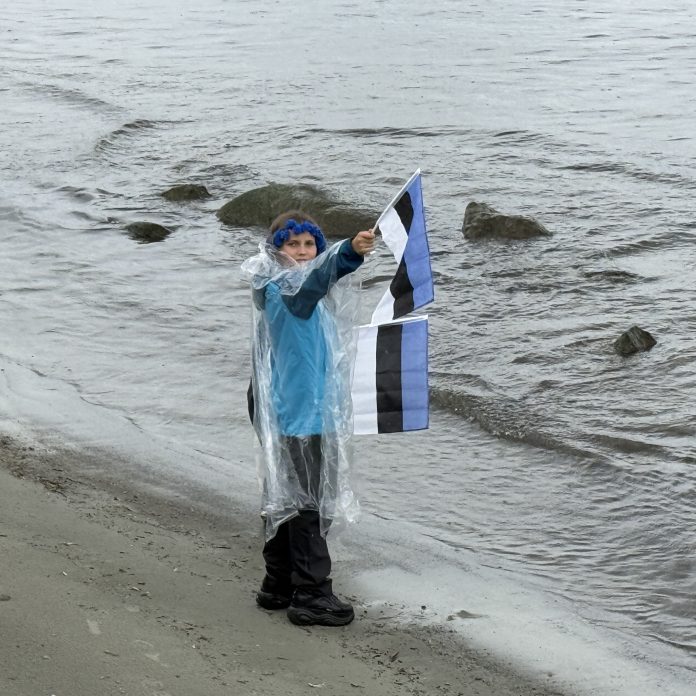
It is stubborn hope wrapped in blue, black and white — the colours we were forbidden to wear only two generations ago.
So let us guard our freedom — wisely, courageously and together.
Hoidkem oma vabadust — targalt, julgelt ja üheskoos.
Thirty-five years after freedom finally walked through the door, she is still here. That deserves celebrating. Join us in raising an imaginary glass to freedom. Vabadusele!
💙🖤🤍
Acknowledgement
This article is based on a speech by Kristel Alla, delivered at the Independence Day celebrations on 1 March 2026 at Estonian House in Melbourne.
Read more
Estonia is 35 years free again — celebrate across Australia | HEIA
Estonia celebrates the restoration of independence | Estonian World

