

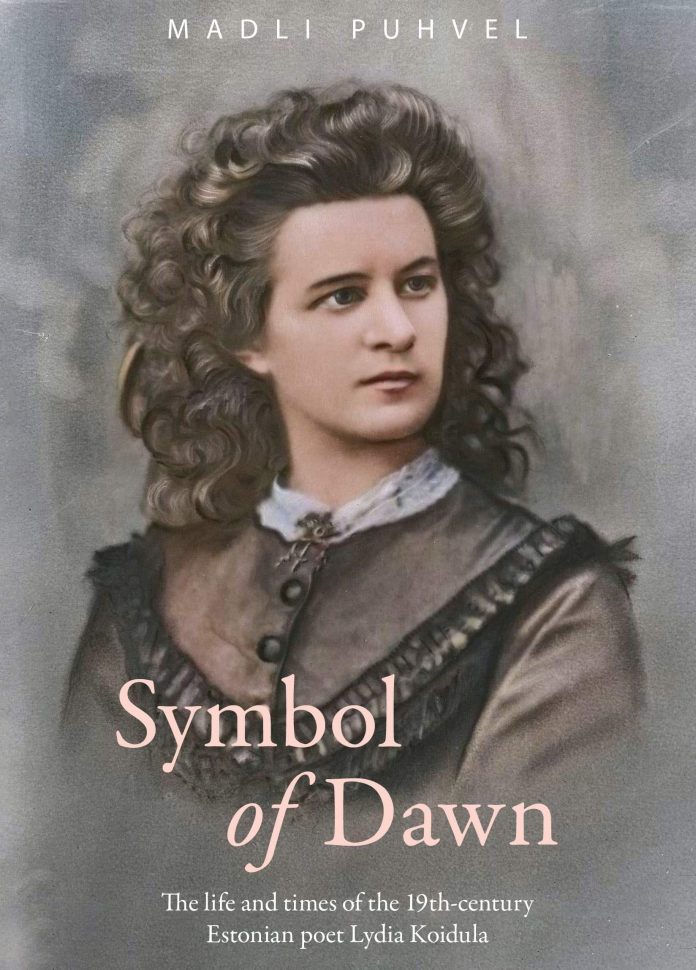
The University of Tartu Press has just released a fresh edition of “Symbol of Dawn: The Life and Times of the 19th-Century Estonian Poet Lydia Koidula” by Madli Puhvel.
First published in 1995 (with a reprint in 1999), this landmark English-language biography is now available again in an updated, beautifully designed edition with a few edits compared to the earlier version. An Estonian translation appeared in 2016/17 — both print runs sold out — but for English readers, this re-release is a rare chance to discover Koidula’s remarkable life and work.
More than a literary biography, Symbol of Dawn is also a vivid introduction to Estonian history and culture, written in clear, engaging English for an international audience. Drawing extensively on Koidula’s personal letters, Puhvel examines not only her creative achievements but also her role as a woman navigating the social constraints of her time.
Who is the author Madli Puhvel?
Born in Estonia and educated in England, Canada, and the United States, Madli Puhvel holds a doctorate from the University of California (UCLA). Alongside a distinguished academic career as a research scientist and professor of medicine at UCLA, she has nurtured a lifelong passion for literature, history and biography. Living most of her life in California, Puhvel brings both scholarly insight and international perspective to her writing. Symbol of Dawn reflects her deep connection to Estonia’s cultural heritage and her gift for making it accessible to English-speaking audiences.
Who was Lydia Koidula?
Lydia Koidula (1843–1886), born Lydia Jannsen, is often called the “mother of Estonian poetry”. She was the first great poet to write in Estonian, at a time when it was still unusual — even frowned upon — for women to publish their work. Her patriotic verses inspired a nation just emerging from centuries of serfdom, encouraging pride in the Estonian language and identity.
Koidula’s influence reached beyond poetry. She was also a journalist, playwright, and central figure in Estonia’s national awakening, working alongside her father, Johann Voldemar Jannsen, and cultural leaders such as Carl Robert Jakobson. Her poem Mu isamaa on minu arm (“My Fatherland is My Love”), set to music by Estonian composer Gustav Ernesaks, became an unofficial anthem during the Soviet occupation.
Though her life was marked by personal hardship and illness, Koidula’s literary legacy is woven into Estonia’s cultural fabric — from streets and schools bearing her name to the annual celebrations at the Koidula Museum in Pärnu, Estonia.
Where can I buy the book?
📚 Buy the book (EUR 15.00) from the University of Tartu Press
Read more
Read more about this book on the University of Tartu website here
More about Lydia Koidula in the Estonian Writers’ Dictionary
Lydia Kodula museum (in Estonian)
Acknowledgement
Thank you to Ivo Volt from the University of Tartu Press and Ave Nukki from the Estonian Society of Sydney for forwarding this information!

