

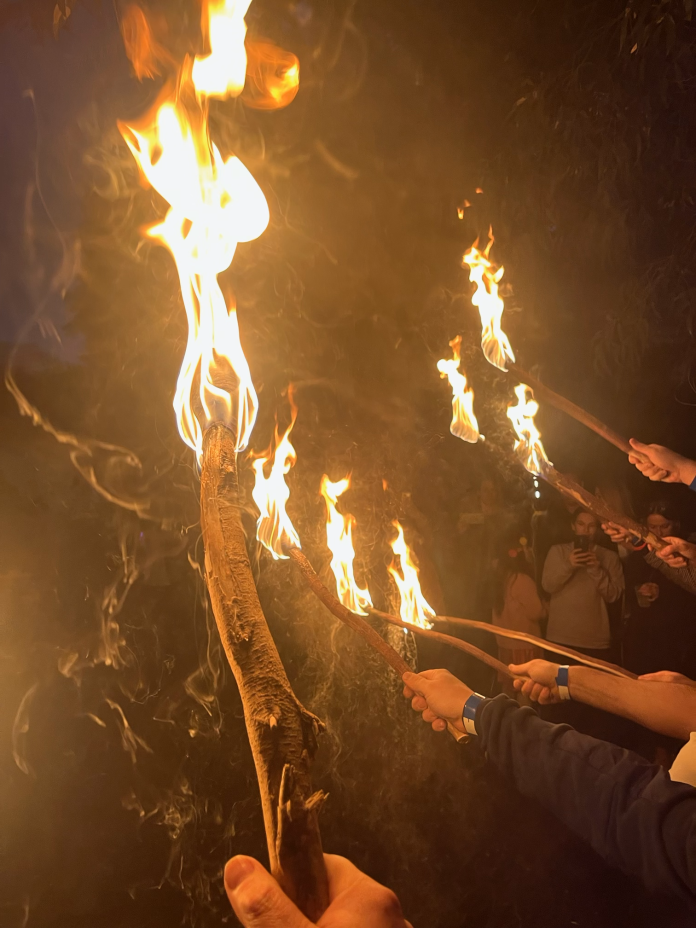
Perth’s Baltic midsummer celebration, 14 June 2025, was a joyful experience – plain good fun – but also fresh shoots of cultural change.
The event was held at the Latvian Centre in Belmont, a hall proudly hand-built in 1972 by the post-war wave of Latvian immigrants. The building, filled with decades of memorabilia, served as a poignant reminder of how those displaced from their homeland worked to preserve their culture from half a world away.
The story of Perth’s Estonian community is similar. However, the Estonian Centre, Eesti Tare, was sold years ago as the first generation of Estonians aged and their Australian-born children – cut off from their ancestral roots by the Iron Curtain – melded into Australian culture. The Latvian Centre has experienced a similar decline in community but has carried on through dual use as St Paul’s Lutheran Church (a subtle irony, given the day’s pagan origins) and traditional cultural activities like folk dancing.
So it made perfect sense to host a combined midsummer event – Jaanipäev for us – at the last remaining Baltic hall in the city, bringing together the combined force of the Estonian, Latvian, and Lithuanian communities to create a critical mass…
And that’s when it became clear that a change of seasons is upon us.
The event sold out all 350 tickets a week in advance, with a growing waitlist behind. On the day, attendees braved drizzly, wintry weather to stream in from mid-afternoon. An older Latvian told me he had never seen the venue so full.
Anecdotally, around 80% of attendees were Estonian. Western Australia has seen a steadily increasing Estonian population, and it’s showing no signs of slowing. There were very recent arrivals, pale from the (lack of) northern sun, who had yet to experience their first Australian summer. And there were those weathered from working for years in more towns and states than many born-and-bred locals have visited. The common thread was resilience – a willingness (and often necessity) to take on demanding jobs in remote places. Hello WA!
Among the crowd were a handful of descendants from the original post-war Estonian migrants (this author included), but the vast majority of attendees came of age well after Estonia’s re-independence, revelling in their freedom to explore the world. Many travel back to Estonia regularly, which is one reason this celebration was held before the actual solstice – why settle for one midsummer when you can have two?
Australia has been a top destination for young Estonians since the Working Holiday Maker agreement was signed in 2005. Estonia’s annual 417 visa quota is uncapped and well utilised, with over 1,300 visas granted in 23/24. By contrast, Latvia and Lithuania do not currently have access to this arrangement – helping explain the disparity in attendance.
With the growing numbers comes the scale to build a fresh cultural zeitgeist. Perth’s new Estonian Association, EstWest, was the driving force behind this and other events, and it’s clear they have tapped a rich vein of interest.
Anyone who has experimented with sourdough knows that its microbial community needs to be fed. A societal culture is no different. Without a fresh influx of “flour and water,” the culture will die. The Perth Estonian community is a good example of how close it can get. After sustaining community with teaspoon-sized doses over the last couple of decades, the new members of the Estonian community are like a 20-kilo sack of Baker’s Best tipped into a 44-gallon drum – and the culture is bubbling, alive, and growing bigger.
The organic energy was on full display during the day’s activities. Traditional elements were all present – folk dancing, flower crowns, sauna, and of course, the bonfire – but there was a contemporary pulse running through it.
Take the tug of war, for instance. A seemingly unprogrammed wave of momentum led a large group of adults to a dimly lit side alley where it seemed something ritualistic was about to unfold. Men stripped off outer layers, revealing the kind of physical conditioning born of work in WA’s agriculture, mining, and construction sectors, as they lined up astride a rope thick enough to moor a Panamax. The alley, churned with mud from rain and boots, offered a splash of Baltic authenticity. One side was a team of Estonia’s finest; the other, a mixed Baltic crew. Two loud, primal, and fiercely short and sharp rounds later, Estonia had the win over the All-stars. And just as quickly, the crowd dispersed, seeking warmth and shelter. This wasn’t for show. It wasn’t staged for Instagram. It meant something.
Was the evening exactly like a midsummer in Estonia? No. The gum trees, early sunset, and Aussie accents made sure of that. But it was an authentic celebration of Estonian culture in an Australian context. And perhaps most importantly, it wasn’t a relic of a fading past – it was living, breathing, evolving tradition at work.
Welcome back.

