


On the 11th of September, Estonia will celebrate the 90th birthday of its beloved composer Arvo Pärt. While there have been commemorations of this event throughout the summer and across Europe, these nine days are just about Pärt and his music and will be shared in concerts across Estonia.
The opening concert by ERSO, Vox Clamantis and Eesti Filharmoonia Kammerkoor was performed in Pauluse Kirik in Tartu on the 2nd of September and Estonia Konterdisaal in Tallinn on the 3rd of September. A further eight concert programmes will be performed in churches and concert halls across Estonia in Narva, Viljandi, Viimsi, Paide, Kärdla, Rakvere, Kuressaare and Rapla as well as the Arvo Pärdi Keskus which is dedicated to the preservation of and research into his music.
While over the last decade Arvo Pärt’s success has begun to be a well-worn cliché and many Estonian musicians have wanted to get out from under his shadow and forge their own path, the fact that for the last 20 years Arvo Pärt and John Williams have traded top position as most performed living composer is extraordinary given the vast number of film themes Williams has composed.
Estonian conductor Paavo Järvi feels that Pärt’s success is because “his music touches some personal part inside us, that longs to be calmed in this world of noise and information” (Mezzo.tv interview). He describes how after many years as an avant-garde composer producing jarring music full of dissonance, Pärt was silent for several years and decided only to make music that spoke of a fundamental spiritual truth.

This year Paavo dedicated his Pärnu Music Festival in July to Pärt and particularly mentioned the brotherhood between Pärt and his father Neeme Järvi, dedicating an impromptu performance of Fratres to them both. “When the Soviet authorities banned Arvo’s music after one performance because they discovered some religious meaning, my father would play it again the next night. In the end, they were so embarrassing they were allowed to leave the country,” he said during an interview on Mezzo.tv.
The celebration of Arvo’s music has extended across the world this year with hundreds of performances of his music including at the BBC Proms in London, dozens of cities in Europe, Brazil, Japan and Australia. I attended performances in the 13th century cathedral in Turku, Finland where I saw firsthand the power of Pärt’s music on ordinary people. The open rehearsal in the cathedral gradually gathered more and more visitors to the front, many filming this extraordinary music on their phones in the calm, beautiful building.
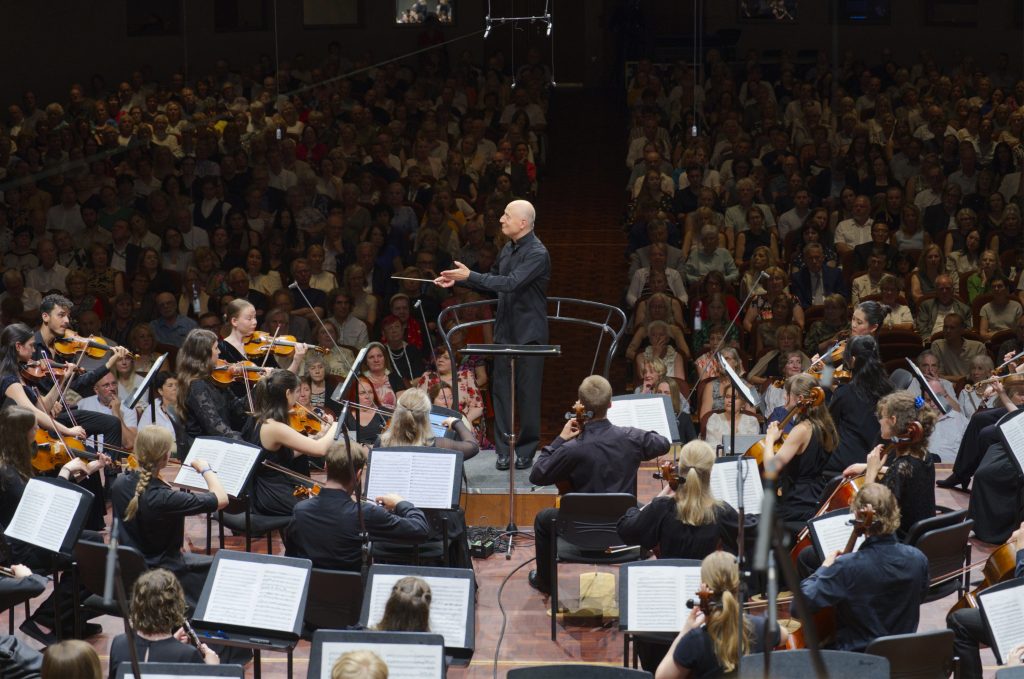
During this year of celebration, researchers of Pärt’s music have been discussing the importance of his music, particularly his Tintinnabuli. Many people hear this word and think of bells, either church bells or his works that feature them. However as one researcher put it in the documentary film The Lost Paradise, A portrait of Arvo Pärt by Günter Atteln: “when you strike a bell, you get a pure tone, which fades to a point when you no longer know if the sound is playing or has stopped.” This space between sound and silence is encapsulated at the end of Cantus, which Arvo’s wife Nora Pärt describes as: “The last chord … refuses to end; it stays there, without increasing or diminishing. It is something achieved and which no one wants to give up.”
Maarja Tyler from the Arvo Pärt Keskus explained in Pärnu that Tintinnabuli is one of only two new musical compositional systems created in the 20th century. It is not just a style or a sound but a fundamental structure for creating music that can be used by anyone to create their own music and forge their own path. That is a gift to humanity worth celebrating.
Palju õnne 90. sünnipäevaks, Arvo! Happy 90th birthday, Arvo!

More information
Mezzo.tv: The Lost Paradise, A Portrait of Arvo Pärt
Read more about the Pärnu Music Festival here and watch concerts here

