

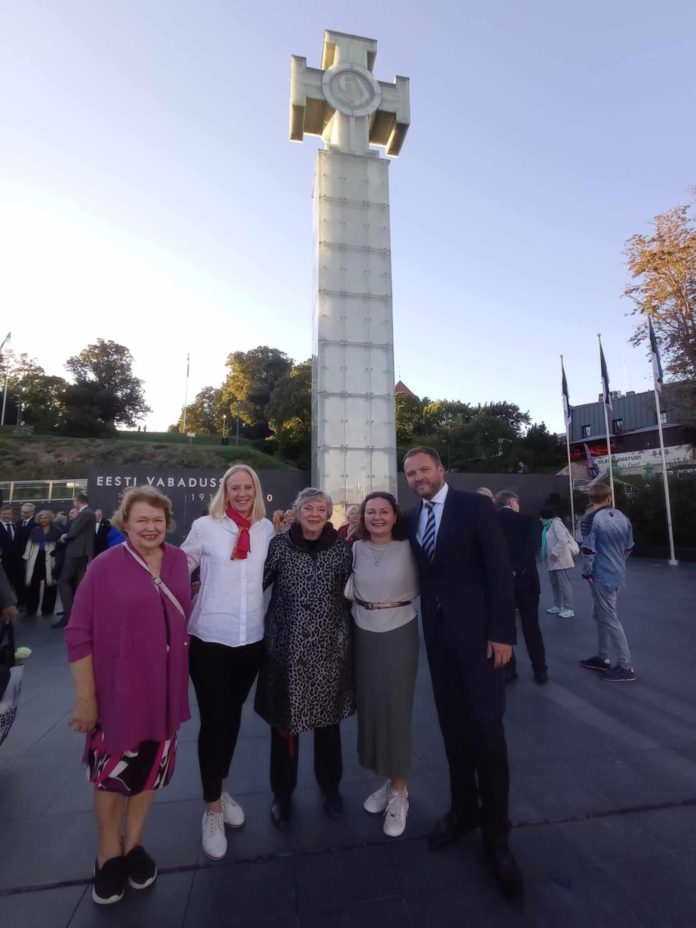
It has been a year since the 80th commemoration of the Mass Flight of 1944. This year the occasion will be more modest, with the Mass Flight working group arranging a concert of Eduard Tubin’s music at the Tallinn College of Music and Ballet. I wonder whether the many Estonian organisations that participated last year will mark the day again.
I have been a member of the Mass Flight 1944 (MF 1944) working group for eight years. The group was formed by the Estonian World Council (ÜEKN) to raise awareness of this tragic event in Estonian history. In the autumn of 1944, an estimated 80,000 Estonians fled west to escape the advancing Soviet army. Many perished at sea, so we will never know how many set out — only how many arrived on other shores.
In 2019, for the 75th anniversary, the group arranged a seminar at VABAMU, an exhibition in the Theatre Museum, a wreath-laying ceremony at the Cross of Freedom, and a church service in St John’s Church. Yet none of these activities gained attention from the local newspapers, radio or television and audiences were small. The Mass Flight was not talked about for 50 years, it does not feature in the school history books and was an unpopular topic for many people.
We did not give up. Each September we organised talks for schoolchildren, plays and essay competitions to keep the memory alive. Slowly, we found likeminded organisations in Estonia willing to support our work.
Last year, for the 80th anniversary, everything changed. There was extensive print, TV and radio coverage. Museums, churches, city councils, schools and the Estonian government all took part.
Highlights are described below.
Seminars and exhibitions. The Institute of Historical Memory introduced its refugee database at a seminar in Haapsalu. University of Tartu hosted an exhibition of works by artists from the Geislingen displaced persons camp alongside Ukrainian refugee artists now living in Estonia. The Pärnu Museum displayed photographs from post-war displaced persons camps.
Church and community events. Services were held in Haapsalu, Tallinn, Tartu and Pärnu. At 5.45pm on 19 September, bells rang out across Estonia in memory of those who fled. The Estonian government held a wreath-laying at the Cross of Freedom in Tallinn, while President Alar Karis cast a wreath into the Gulf of Finland to honour those lost at sea.
Discussion series. The Oak Tree Club, with EU support, launched the program “Don’t want to go but can’t stay”. Seminars ranged from women’s expatriate stories to the turbulent autumn of 1944, with speakers from Estonia, Australia and abroad. A short play based on the memoirs of Mari Raamot was performed, and further discussions were hosted at the Estonian parliament and VABAMU.
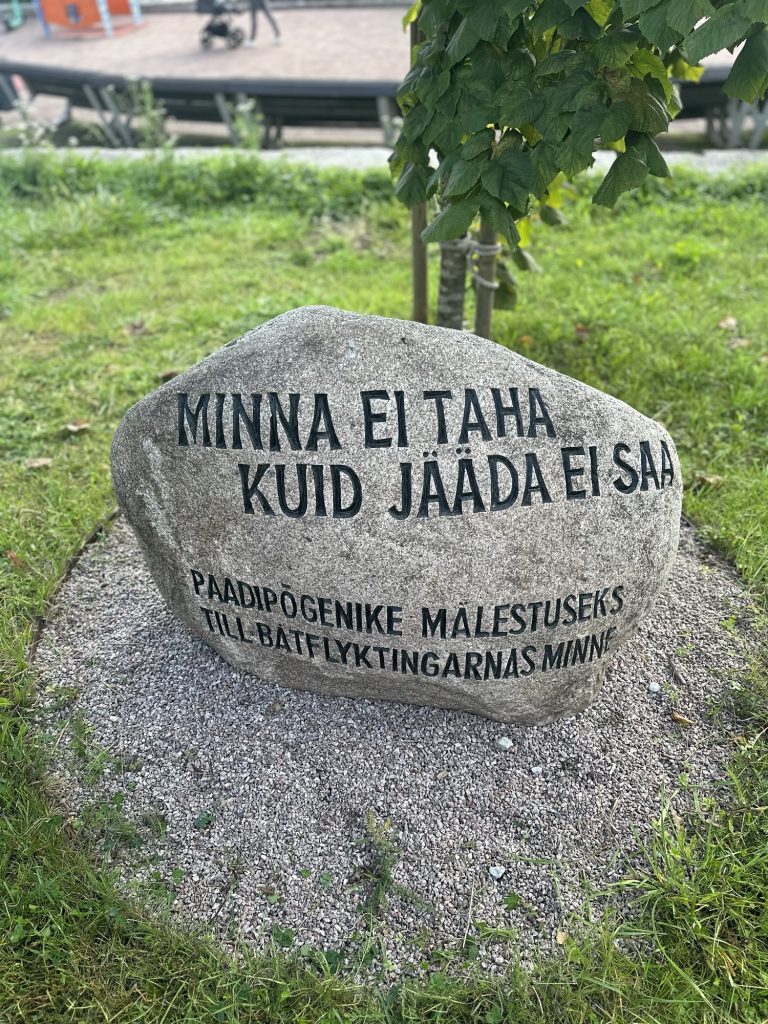
School engagement. In Tallinn, the ÜEKN Mass Flight 1944 group organised a meeting between refugee expatriates and senior students at Tallinn Real School, followed by a wreath-laying at the memorial stone and a memorial service at St John’s Church.
The main event for the working group was the unveiling of the memorial in Pärnu on the 21st of September. The sculpture by Elo Liiv, funded largely by diaspora communities in the USA, Australia and Canada, now stands near the city bridge. Once the riverbanks are stabilised, it will be moved to its permanent site with lighting and landscaping. Do go and visit it when you are in Pärnu.
The unveiling was a remarkable day: sunshine, choirs, flags and a large audience. The ceremony was opened by Iivi Zajedova, chair of the working group, followed by speeches from President Toomas Hendrik Ilves, Pärnu’s mayor Romek Kosenkranius, Marin Mõttus of the Foreign Ministry, and committee members including Marju Rink Abel, Ülle Ederma and Kristi Vuht Allpere (Kristi led the memorial project). The Pärnu City Council gave its strong support, and ÜEKN formally gifted the sculpture to the city. Bishop Emeritus Tiit Salumäe blessed the monument before it was unveiled by members of the working group.
That evening, at the Estonian Symphony Orchestra concert, conductor Neeme Järvi dedicated a piece to the memory of those who fled in 1944.
It has been a long journey, but this important part of Estonia’s history is finally being discussed openly. It is no longer only the diaspora who remember, but Estonians everywhere.
Links
My daughter Kristi took this video of the unveiling of the Mass Flight memorial in Pärnu.

