

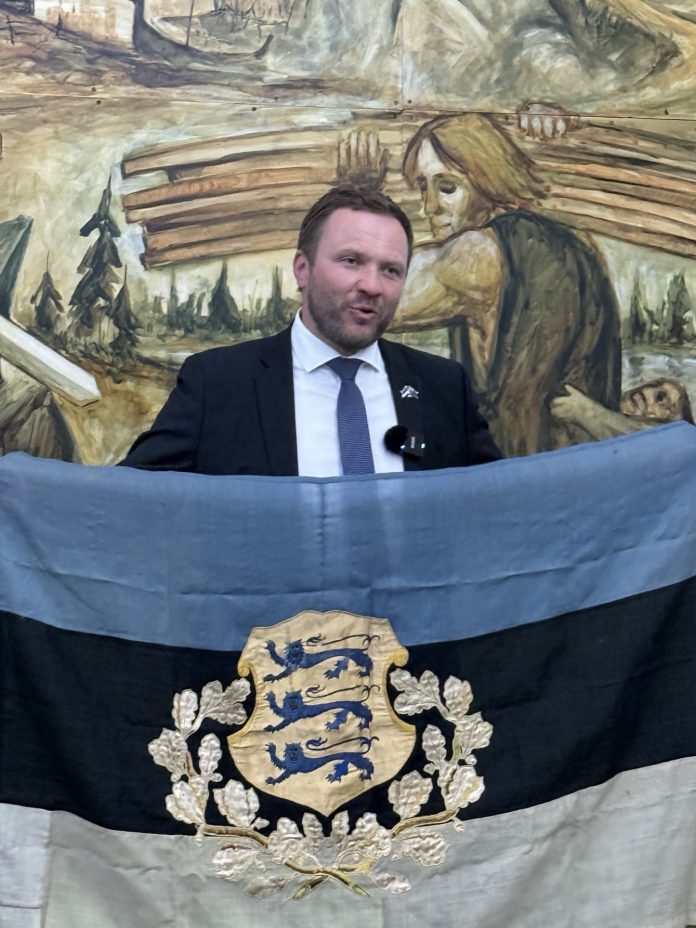
Members of the Estonian community gathered at Estonian House in Sydney this week for an evening with Estonia’s Minister of Foreign Affairs, Margus Tsahkna, during his official visit to Australia.
Held on 10 March 2026, the event brought the community together for a fascinating discussion on Estonia’s place in a changing world. It savoured a message that Estonia today is freer, stronger and better protected than ever before, but must remain united and never stand alone again.
The evening also included a symbolic moment: the formal presentation of a historic Estonian flag, preserved in Australia for more than 80 years, which is now returning home to Estonia.
A house with a story of its own
The event opened with welcoming remarks from Sydney Honorary Consul Sulev Kalamäe, who reflected on the special place Estonian House holds in the story of Estonians living in Australia. Built by local Estonians, Sydney Estonian House was the first purpose-built Estonian House established outside Estonia. The building officially opened in 1940 — only months before Estonia was occupied by the Soviet Union. For decades afterwards, the house became more than a community hall — it served as a cultural and symbolic anchor for Estonians on the other side of the world. Kalamäe described it as, in many ways, “a little bastion of freedom and independence” far from occupied Estonia.
He also acknowledged the difficult global backdrop — including the continuing war in Ukraine and rising instability in the Middle East — noting that in such times the opportunity to hear directly from Estonia’s Foreign Minister felt especially meaningful.
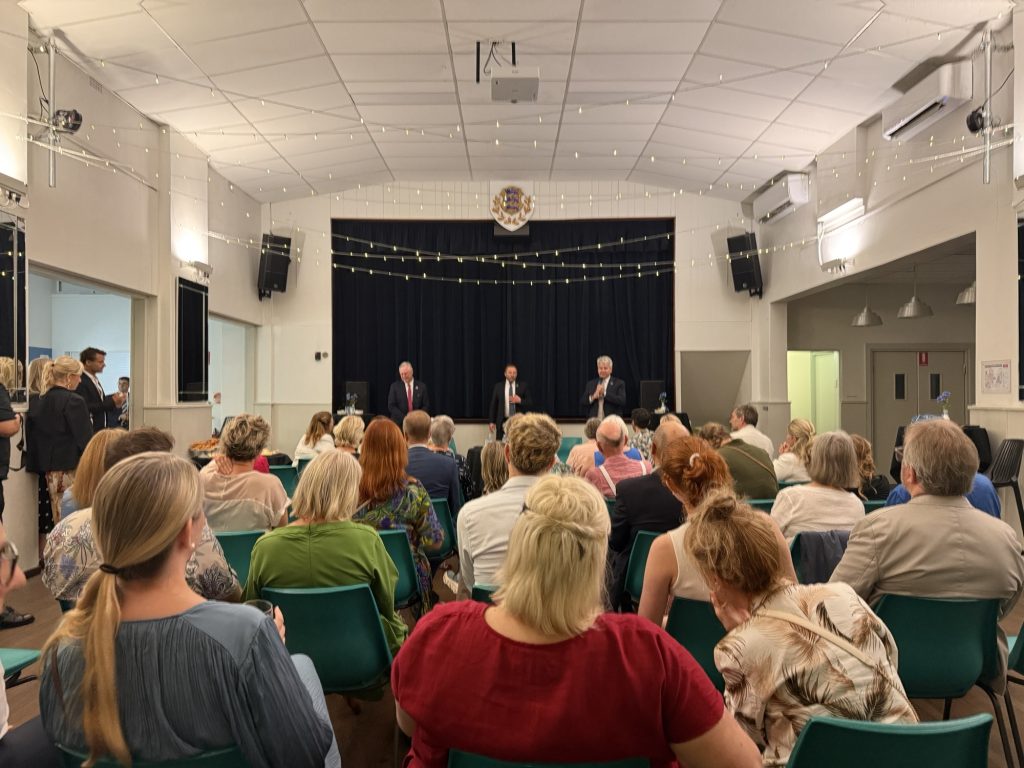
Minister Margus Tsahkna began in Estonian, speaking not only about foreign policy, but about history, memory and what Estonia has learned from it.
He told the audience that, despite anxiety and uncertainty in the world, Estonians today are in many ways living better than at any other point in their long history: free, able to travel, able to build their lives and future. But, he stressed, the restoration of Estonia’s independence was built on two fundamental understandings drawn from history.
The first was that, if Estonia were ever attacked again, it would resist from the very first moment. The second was that Estonia must never again be left alone. “We will resist,” he said. “And we will never be alone again.”
That message became one of the defining threads of the evening. Estonia’s path over the past three decades, he said, has been shaped by precisely that goal: building strong ties with like-minded countries and ensuring that neutrality and isolation would never again leave the country exposed.
The audience discussion that followed ranged widely, with many questions focusing on the war in Ukraine, Russia’s ongoing aggression, and the broader security situation in Europe.
Minister Tsahkna spoke about his recent visit to Ukraine, where he met President Volodymyr Zelensky and saw again the determination of Ukrainians to continue defending their country despite relentless attacks and immense hardship. He told the audience that, in his view, Russia has not achieved a strategic breakthrough on the battlefield, even as it continues to inflict suffering on civilians and target essential infrastructure.
At the same time, minister was clear in his assessment of Estonia’s own position.
“Estonia is stronger than ever before,” he said. “We are living the best life we have ever lived as a country.”
He noted that Estonia is better protected today than at any point in its history: NATO troops are present in the country, allied air policing missions continue, Estonia’s own defence preparedness has grown, and Finland and Sweden have joined NATO, fundamentally changing the region’s security picture.
He also pointed to the strength of public resolve inside Estonia. According to recent survey results he cited, more than 90% of people in Estonia believe the country should resist militarily if attacked, while 74% say they would personally be prepared to take part in that defence.
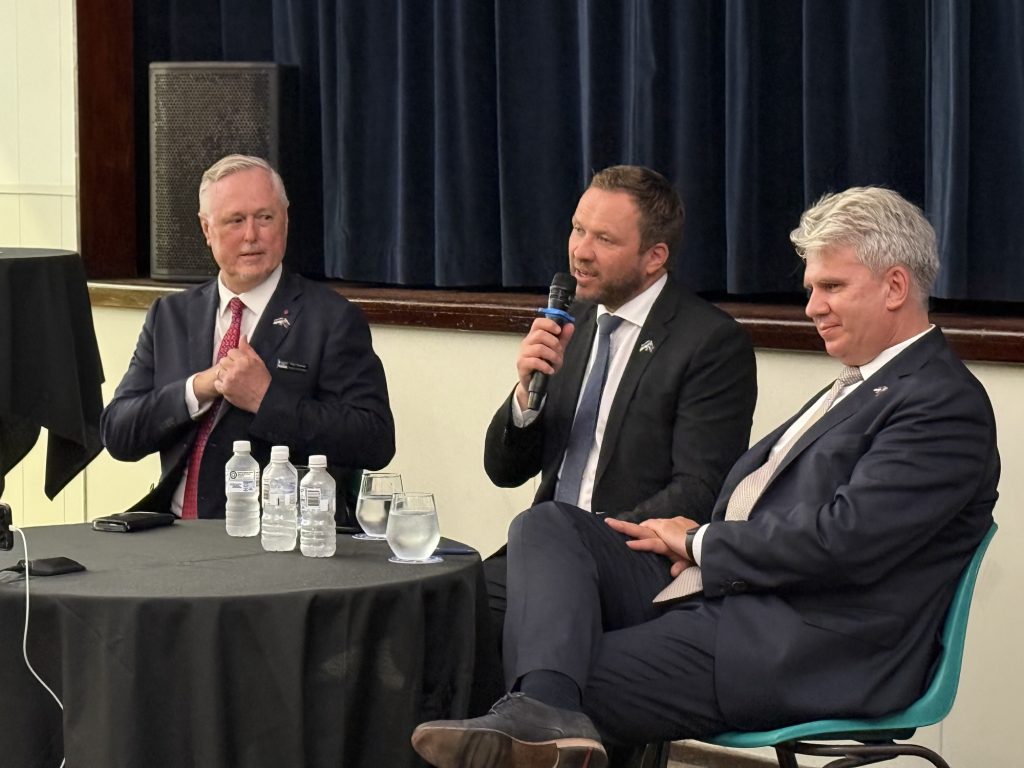
Yet one of the minister’s strongest messages was not only about military readiness, but about social cohesion. He spoke candidly about frustration, division and the culture of constant complaint that can take hold in democratic societies, especially after years marked by pandemic disruption, economic pressure, war and global uncertainty.His concern, he said, is not only external threat, but the risk of societies becoming fractured from within.
“My biggest concern is how we keep our societies together,” he said. “How we avoid letting ourselves be divided by unnecessary conflicts or misinformation.”
That theme carried through the discussion on propaganda, disinformation and the spread of manipulative narratives. He warned that the most serious attacks on democratic societies do not always come in military form. Increasingly, they come through attempts to inflame everyday divisions, distort public debate and weaken trust.
For Estonia, he suggested, resilience means not only military preparedness, but remembering what has held the nation together across generations: shared memory, shared language and a clear sense of what freedom means.
The minister returned several times to the Estonian language and the unusual perseverance of Estonia as a people.
He described Estonian as a small and improbable language — one spoken by only around a million people, yet still carrying its own worldview, logic and cultural force. In his words, language is not simply a tool of communication, but something that shapes thought itself.
He spoke with pride about efforts to ensure that Estonian continues to thrive in a changing technological world — including in digital tools, artificial intelligence and future systems of communication.
His message to the community was not only to preserve Estonian identity as memory, but to carry it forward with confidence: through language, culture, innovation, business and connection across borders.
The discussion also moved well beyond security.
Minister Tsahkna spoke about Estonia’s strengths in digital innovation, cybersecurity, defence technology and entrepreneurship, and about the opportunities to deepen practical collaboration with Australia.
A major focus of his visit is economic and strategic collaboration, including in the area of critical minerals and rare earths.
Minister noted that Estonia is already a major producer of rare earth materials and magnets outside China, and that cooperation with Australia in this field holds significant promise.
He also referred to the historic contribution of Sir Arvi Parbo, the Estonian-born mining executive whose influence on Australia’s mining industry remains widely recognised. That, too, he suggested, is part of the deeper story linking Estonia and Australia.
Questions from the audience also touched on the role Estonian entrepreneurs and diaspora networks can play in strengthening these relationships.
In response, the minister highlighted the value of communities abroad not only as keepers of culture, but also as connectors, advocates and partners in opening new pathways for business and investment.
“We are known globally as innovative people,” he said. “Our entrepreneurs have already proven that Estonians can build successful companies anywhere in the world.”
Ambassador H.E. Jaan Reinhold echoed that point, encouraging Estonians in Australia to continue acting as storytellers and builders of bilateral ties — not only through culture and community life, but also through business and professional networks.
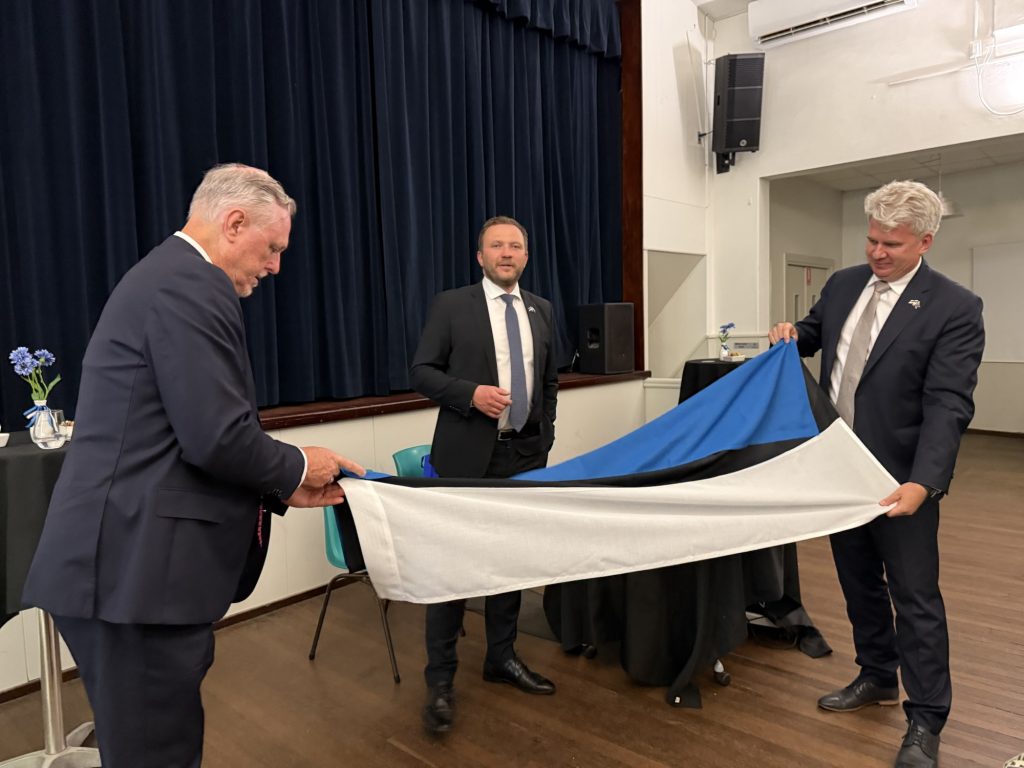
One of the most memorable moments of the evening was the presentation of a historic Estonian flag that had been preserved in Australia for more than 80 years.
The blue-black-white tricolour was carried out of Estonia in 1944 as Soviet forces reoccupied the country. Saved from falling into Soviet hands, it later made its way through post-war Europe to Australia, where it remained in the care of one family for decades. Now, after more than eight decades in exile, the flag is returning to Estonia and will be entrusted to the Estonian National Museum in Tartu.
Its handover in Sydney gave the evening an added emotional and historical weight. At an event already shaped by discussion of diplomacy, security and Estonia’s future, the flag served as a tangible reminder of Estonia’s past — and of the role diaspora communities have played in safeguarding pieces of national history far from home.
Although the discussion touched on many serious international issues, the evening was not defined only by geopolitics. It was also about continuity: the continuity of language, memory, institutions and community. It was about the relationship between Estonia and its people abroad, and about the ways those ties continue to matter — culturally, politically and personally.
Minister expressed heartfelt thanks to the Estonian community in Australia for keeping Estonian language, culture and identity alive so far from home.
He noted the importance of choirs, dance groups, young people, and participation in events such as the Song and Dance Celebration — not only for diaspora communities themselves, but also for those in Estonia. His hope, he said, is that Estonian life in Australia continues not only as a remembrance of the past, but as part of the thriving future.
Alongside the serious talk of security, strategy and international cooperation, there was also a quieter message running through the evening: that Estonia, despite all it has faced, remains here — thinking ahead, building connections, and carrying its story forward. And we can all contribute to this story, helping out in small and big ways.
Thank you for coming, Foreign Minister Margus Tsahkna! We very much enjoyed your visit. Come again soon.

