

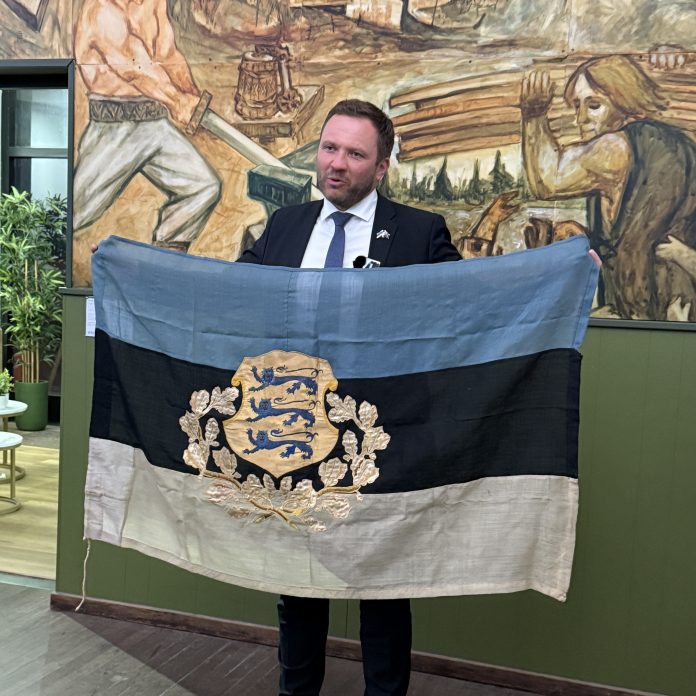
The President’s Standard — rescued from Soviet forces in 1944 and safeguarded in Australia for decades — has returned to Estonia after 82 years, carrying with it a remarkable story.
During the final phase of the Second World War, Estonian constitutional leaders made a brief but historically significant attempt to restore the independence of the Republic of Estonia before the return of Soviet occupation.
Following the deportation of the President of the Republic of Estonia, Konstantin Päts, to Russia in 1940 during the Soviet occupation, the last lawful Prime Minister of Estonia prior to the Soviet annexation, Jüri Uluots, assumed the duties of the President in accordance with the Estonian Constitution of 1938. In September 1944, during the withdrawal of German forces and the advance of Soviet troops, Uluots appointed a new government of the Republic of Estonia, headed by Otto Tief. The government sought to restore Estonia’s independence and to represent the legal continuation of the Republic of Estonia during the transition between the first Soviet occupation (1940–1941) and the German occupation (1941–1944).
The government formally declared the restoration and continuity of the independence of the Republic of Estonia. The Estonian national flag was raised at Pikk Hermann Tower, and the President’s flag (the President’s Standard) was hoisted at the President’s residence, Kadriorg Palace, symbolising the lawful authority and constitutional continuity of the Republic of Estonia.
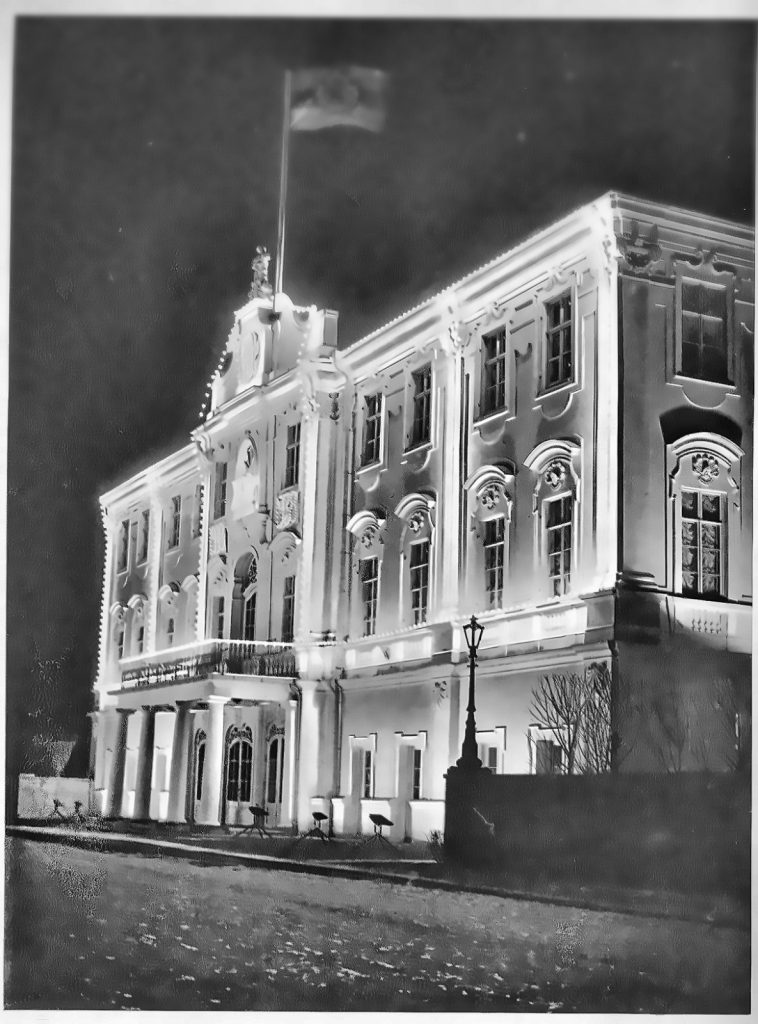
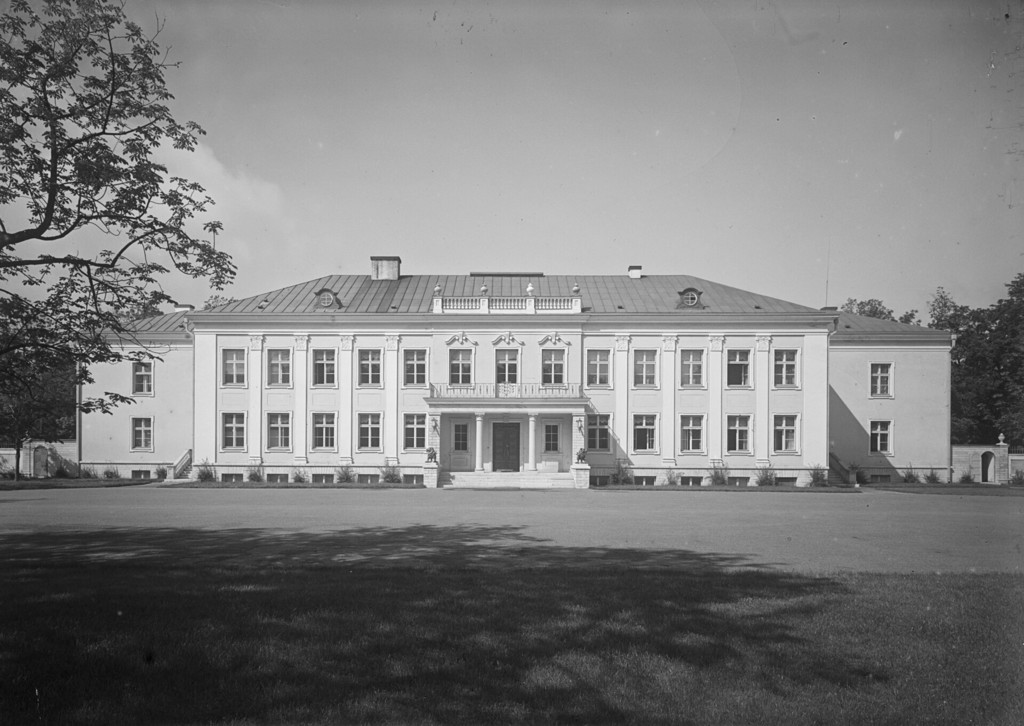
The waving of the President’s Standard indicated the President’s presence within the entire Kadriorg Palace complex, which included the palace itself, the administrative building, and outbuildings. The administrative building, newly built in 1938, housed the President’s Chancellery and offices. When the President moved into the administrative building, he was still considered to be present in the whole complex. The Standard was flown exclusively on the palace mast, located at the center of the roof above the fronton, symbolising the President’s presence throughout the complex, not solely within the palace itself.
When the President travelled outside Tallinn — for example, to the summer residence at Oru Palace — the Standard at Kadriorg was taken down. This protocol emphasised the unity of the presidency as an institution and the person of the President — the flag “followed” the President in his official duties.
It is believed that the administrative building was abandoned first by the German authorities due to its lesser importance, while Kadriorg Palace, the official residence, was left empty only at the very last minute, around 20 or 21 September 1944. This sequence left a brief opportunity for the President’s Standard to be hoisted over the palace — probably for a day or only a few hours — before it had to be taken down again.
According to Eugen’s family, the Standard was carefully taken down by the 14-year-old Estonian boy Eugen Vilder, who, as a senior scout, carried out this act together with a young Estonian soldier in order to prevent it from falling into the hands of Soviet troops. He had been raised in a patriotic spirit, with a strong sense of duty to protect his homeland. Amid the chaos of the evacuation, Eugen left the city with his mother and sister, carrying the rescued flag with him.
As a result of his action, the Standard survived the war, was eventually taken to Australia via Germany, and has now returned to Estonia after 82 years, confirming a tangible connection to the constitutional continuity of the Republic of Estonia in that difficult time. The flag served as a powerful symbol to the world that Estonia’s constitutional institutions continued to exist and function, despite one occupation being replaced by another.
The flag also served as a signal to the advancing Soviet forces that they were entering a country whose independence had just been restored, though Eugen acted to protect it from falling into their hands.
According to the memoirs of Elmar Tambek, the head of President Päts’s Chancellery, he went to Kadriorg on 19 or 20 September 1944, during the final days before the Soviet arrival. He entered the presidential administrative building, where the offices of the President and the Chancellery had been located and where he had previously had his official apartment. Finding the building abandoned, Tambek took measures to secure the President’s offices and Chancellery rooms to prevent vandalism and looting. Shortly afterwards, he too was forced to leave before the advancing Soviet forces.
Today, the former President’s administrative building is used as the official President’s residence, housing the Chancellery and offices. The President’s Standard now flies permanently on the building whenever the President is in the country. The difference from 1944 lies in the strength of the institution: under the 1938 Constitution, the President had extensive executive powers and a central role in state affairs, whereas today the President’s powers are more ceremonial under the 1992 Constitution, reflecting Estonia’s parliamentary system.
About the author
Mart Soesson describes himself as a Sydney-based lawyer and former athlete with a deep interest in history, heritage and legal matters. He has been involved in the Australian-Estonian community for more than 30 years and played a key role in strengthening bilateral relations, including initiating the December 2000 Working Holiday agreement between Australia and Estonia.
His cultural contributions include participation in the early stages of the choir Lõke (1996), delivering the 2001 Estonian Independence Day speech (published in Meie Kodu), and performing with the poetry theatre group Muusajüngrid at several Estonian Cultural Days.
A regular participant in Estonian RSL Sub-branch Christmas events, he has also taken part in ANZAC Day marches and related commemorations. Over the years, he has been involved in numerous activities at Sydney Estonian House, including weekly Estonian market nights, theatre productions, concerts and film screenings. He also contributed to the Scandinavian Market and several Finnish Market Halls in Canberra.
Mart has participated in the Sydney Jaani kogudus, been involved with the Estonian Archives in Australia, and contributed to community discussions and heritage initiatives. He has advised others on preserving Estonian history and cultural heritage and has also assisted with maintenance work at Sydney Estonian House. He continues to support and promote the enduring ties between Australia and Estonia.

