

Statistics Estonia has published its latest population figures — revealing a country of 1.36 million people, 224 ethnic nationalities and rather more linguistic variety than its size suggests.
While Australians were dutifully filling in Census forms on 11 August, Estonia had some population numbers of its own to share. And for a country that could comfortably fit its entire population into one reasonably ambitious Australian city, there is quite a lot going on.
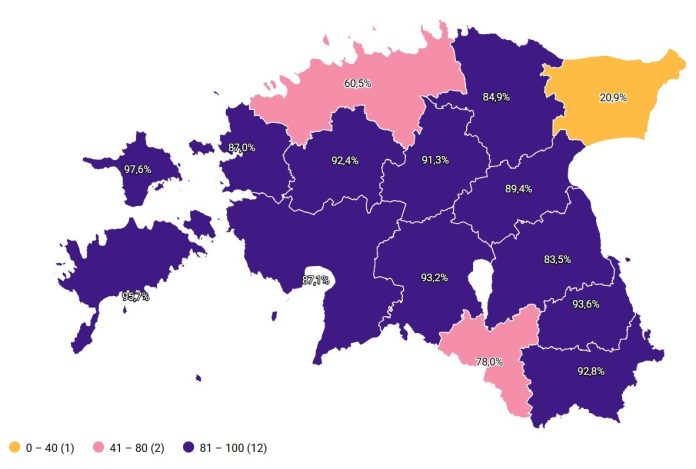
At the beginning of 2026, Estonia was home to 1,360,745 people. Of those, 932,603 — or 68.5% — identified as ethnically Estonian, while 276,125, or 20.2%, were Russian. Another 146,619 people (10.8%) belonged to other ethnic groups.
But perhaps the more surprising number is 224. That is how many different ethnic nationalities are now represented among Estonia’s residents — 23 more than at the 2021 census. Before we start imagining enormous new communities appearing across the country, Statistics Estonia notes that many of those newly recorded nationalities are represented by just one or two people.
Despite Estonia becoming increasingly diverse, the number of ethnic Estonians has remained relatively stable since 2018. The number of Russians has declined over the same period, while the Ukrainian population has grown considerably.
Ukrainians are now Estonia’s third-largest ethnic group, with 75,250 people, representing 5.5% of the population. Their numbers have roughly tripled since the beginning of 2022, when 27,826 Ukrainians lived in Estonia.
Other sizeable communities include Belarusians, Finns and Latvians. Estonia is also home to nearly 3,000 Germans, more than 2,000 Lithuanians and Tatars, and growing numbers of Azerbaijanis, Turks and Indians.
The statistics become even more interesting when you stop counting nationalities and start counting languages: 1.36 million people, 262 mother tongues.
At the beginning of the year, Estonia’s residents reported 262 different mother tongues. Estonian was the mother tongue of 65.4% of the population, followed by Russian at 26.9% and Ukrainian at 4.1%. More than 5,000 people reported English as their mother tongue and almost 4,000 Finnish.
And 77 of those 262 languages are spoken as a mother tongue by only one or two people in the entire country. So somewhere in Estonia, statistically speaking, there may be a language community small enough to hold its annual general meeting over one cup of coffee.
The country’s passports are similarly well travelled. Estonia’s permanent residents include citizens of 159 different countries, although 82.2% of the population holds Estonian citizenship.
For a small country frequently described in terms of what it is losing — population, young people, people to migration — the latest figures offer another view. Estonia remains overwhelmingly Estonian, but the population living within its borders is also considerably more international than its 1.36 million inhabitants might suggest. Turns out you don’t need to be big to contain multitudes.
Read more
People from 224 different ethnic nationalities living in Estonia | ERR (in English)
Eestis elab 224 erinevast rahvusest inimesi | Statistikaamet (in Estonian)

