Friday, May 1, 2026
19.3 C
Canberra
10.2 C
Tallinn

Estonian Sub-Branch of the R.S.L. of Australia website launched

0

The Estonian Sub-Branch of the R.S.L. of Australia has launched their webpage. The webpage aims to:
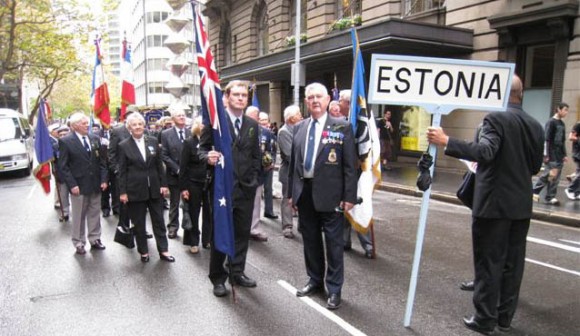
  • introduce the Estonian Sub-Branch of the R.S.L. of Australia
  • detail the aims of the sub-branch
  • share details and photos of their activities over the last 40 years.

anzac_day_parade_2008

The webpage is located at veterans.eesti.org.au

Book Review – Valentina my Little Russian Princess

0

Valentina my Little Russian Princess

After some researching I was able to purchase a book – Valentina my Little Russian Princess. One should not be misled by the title as it has a reason.

To most Estonian pre-war arrivals and their children it is very informative and descriptive of their fate. Personally it brought back memories of my parents’ economic struggles in Estonia and the first difficult years in Australia in the 1930’s in a new country coming into the Depression.

Estonian Sub-Branch of the R.S.L. of Australia website launched

0

The Estonian Sub-Branch of the R.S.L. of Australia has launched their webpage.   The  webpage aims to:

  • introduce the Estonian Sub-Branch of the R.S.L. of Australia
  • detail the aims of the sub-branch
  • share details and photos of their activities over the last 40 years.

The webpage is located at veterans.eesti.org.au

Book Review – Valentina my Little Russian Princess

0

Valentina my Little Russian Princess

After some researching I was able to purchase a book – Valentina my Little Russian Princess. One should not be misled by the title as it has a reason.

To most Estonian pre-war arrivals and their children it is very informative and descriptive of their fate. Personally it brought back memories of my parents’ economic struggles in Estonia and the first difficult years in Australia in the 1930’s in a new country coming into the Depression.

Were you in Scheyville?

0

Roger Donnelly is a part-time PhD student of UNSW@ADFA. He is looking for people who went to Scheyville to interview for his research.

Roger writes:

In 2001 my honours topic, which was on the Officer Training Unit formed at Scheyville during the Vietnam War, was published as a book by University of Queensland Press. The book is titled “The Scheyville Experience”. Now I am doing the total history of the Scheyville site. I wish to interview and/or receive input from people of Estonian, Latvian and Hungarian heritage who went to Scheyville when they and their families migrated here somewhere between 1949 and 1964.

Valentina, my Little Russian Princess

0

A prominent Sydney Estonian resident, Mrs Valentina Craig, has recently had her biography “Valentina, my little Russian Princess” published.

Valentina my little Russian PrincessMrs Craig, now aged 92, fled the Russian Revolution as a child and immigrated to Estonia (her father’s birthplace) and then Australia in 1927 after doctors advised of a warmer climate to treat her tuburculosis. Her father, Alexander Selg, helped with catering for the Estonia Society in Sydney and was active in Estonian community. He operated several delicatessens including one in Miller St, North Sydney.

Her story is full of poignant accounts of struggle contrasted with some very funny accounts, such as her father being thrown off Bondi Beach for indecency in 1927 – for innocently arriving in a Tarzan style lap lap. They also lived in rented rooms of a high class prostitute who worked from home -without realising her profession.

Valentina was refused entry to Sydney University to study law because the Dean felt clients would not trust a “migrant and a woman”. Valentina has led an eclectic life; she was a close friend of photographer, the late Max Dupain for whom she also modelled. Her story begins in Russia before the Communist Revolution and covers the hardships of the Great Depression in Sydney. It also touches on WWII – her first husband Jim was a bombardier on Halifax bombers during the Battle of Britain. He was killed in a crash 10 days before Germany surrendered, leaving Valentina a widow with a young daughter, Julie.

She established an orchid nursery in Sutherland Shire and helped found export cut flower industry. She was a member of the Sutherland Hospital committee and marched on Parliament house to secure funding.

When bushfires threatened homes in Loftus she passed the hat around and bought materials to make a shed to house fire-fighting implements which locals used to fight fires. This was the humble start of the Loftus volunteer bushfire brigade. From her first Ave Loftus nursery, Valentina helped pioneer the export of orchid cut flowers to USA and Europe. She became a world renowned orchid breeder and travel to China to lecture at universities, and was in Tiananmen Square just before the infamous massacre.

The biography has been compiled by former Sutherland Shire Council press officer, Jon Woodworth with assistance from Valentina’s granddaughter Mrs Melita Williams.

“This is a story of a migrant girl who as a ‘new Australian’, struggled to find her place in Australian society,” Jon said.

Copies of the book ($15) can be obtained from the Estonian Archives in Australia , Estonian House, 141 Campbell St. Surry Hills or ordered by email, archives@eesti.org.au. Please add $5 postage and handling if not collecting the book.

Valentina, my Little Russian Princess

0

A prominent Sydney Estonian resident, Mrs Valentina Craig, has recently had her biography “Valentina, my little Russian Princess” published.

Sydney Archivists in Käsmu Summer 2008

0

It’s been over 4 years now since I started working as a volunteer at the Estonian Archives in Australia (EAA). So why should I give up one day’s work every week to sit among a pile of dusty papers and books?

Well, originally, it was to keep up and improve my Estonian language skills but the big surprise was how much I have learned about us – I mean “väliseestlased”, Estonians who don’t live in Estonia. And of course how much I enjoy my work and how great our team of archive workers is.

I really had very little idea of how enormous the contribution to Estonian culture outside Estonia has been and about how absolutely crucial this was in the past and still is in many ways to keep Estonian culture alive and productive all over the world. And of course how interested the “kodu” (home) Estonians are in us. Well, maybe not all the kodu-eestlased but certainly those who are active in Estonian archives and libraries, memory institutions and museums.

And this interest was demonstrated by an Estonian archival summer school, held in Käsmu, Estonia from 17 June to 22 June this year. And which we were invited to take part in.

Estonian archives in America, Canada, England, Germany, Sweden, Latvia, Russia and Australia were represented as visitors and of course our wonderful host country Estonia.

Four of us came from Sydney: Maie Barrow, Raivo Kalamäe, Reet Simmul and Jüri Woan. Tiiu Salasoo and Ann Smith also attended.

So, to Käsmu. A pretty little coastal village just over an hour out of Tallinn by bus. Käsmu is famous for its great but now vanished naval school and ship building facilities. Käsmu is also very proud of the fact that they did not take part in smuggling and selling alcohol to Finland during its period of prohibition in the 1920’s and 1930’s. The film “Tulivesi” (Tallinn 1994) is a good representation of this period.


Käsmu

Our days were spent listening to speakers from various archival institutions from Tallinn and Tartu – and of course we, the visitors, also spoke.

There was a lot to learn. The information was plentiful and useful. Topics included maintaining photography and film, sound and storage of tapes and videos etc. Preserving documents addressing difficult questions of copyright. The content was often very inspiring and also very moving. For example „elulood”, life stories, memoirs and how to conduct oral history interviews.

We were also introduced not only to some great books published by archivists but also to the writers themselves. Rutt Hinrikus and Tiina Kirss presented some fantastic material and inspired us all with their incredible amount of knowledge and conviction.

Maie Barrow and Reet Simmul impressed everyone with an excellent talk and video presentation about the EAA activities in Sydney and Canberra. Our collections, our working routines and our very successful exhibition of Estonian in Australia at the Sydney Powerhouse Museum.

Another very important lecture which had tremendous impact on us was an introduction and insight into the world of digital archives. How and what to scan and digitalise. This is very significant for photography collections.

We also had a lovely time socially. We were about 40 people all together but this changed according to our daily visitors. For those of us who were accommodated at the summer school for the week there were great opportunities networking and very importantly we enjoyed some really nice summer “camp” activities.

We had a great excursion to Palmse and Sagaste manor houses. This included a visit to a War of Independence memorial where we heard of the struggles for freedom over several generations. The weather was fittingly bleak with gray clouds and torrential rain.

Raivo Kalamae, Reet Simmul, Piret Noorhani, Anne Valmas, Maie Barrow and Jüri Woan

We had a guided tour of Käsmu and saw such things as the well known maritime museum, set amongst decaying soviet relics. We also saw the cemetery with its notable Käsmu characters, the writers house, the beautiful forest with its lovely views of the sea, a huge pile of „wishing stones” and a terrible army of very hungry mosquitoes. And we saw the house where poor Jüri Vilms set off for Finland never to return.

There was a film night showing the fantastic 1927 film “Noored kotkad” (Young Eagles) digitally restored this year. And of course there was the tradition of sauna.

We walked, talked, ate and slept together. We studied and swapped stories with each other. All in a great atmosphere of Estonian language, Estonian history, Estonian archives – without the dust and Sass’s great village style accordion playing.

The food was wholesome, plentiful and Estonian. The weather was sunny, warm, cold, windy and one day even a minor flood following an exciting hail storm.

On the last night the entire summer school laulik (song book) was sung. Wonderful. Everyone felt the same, new friends, new information, new ideas and new challenges. We shared a tremendous feeling of achievement and an increased bond and commitment to Estonian archiving. Along with this we felt we were welcomed as Estonians as well as archivists.

A huge thank you to the organisers.

Jüri Woan.

Reproduced with permission from Meie Kodu

Estonia wins Gold in Men’s Discus

0

World champion Gerd Kanter of Estonia has won the men’s discus gold medal at the Olympics.

Gerd Kanter wins gold

Kanter threw a best of 68.82 metres.

He celebrated with a Usain Bolt-inspired 100m sprint, easing up at the line and pointing to the stars.

Piotr Malachowski of Poland took silver with 67.82m and Lithuania’s defending double Olympic champion Virgilijus Alekna claimed bronze with 67.79m.

AFP

Update

Unfortunately all the videos have been removed from YouTube and there is now now way to watch the winning throw or medal ceremony. Very disappointing Olympic Committee ….

Estonia wins Silver in Men’s Double Sculls (Heavyweight)

0

Estonia's Tonu Endrekson and Juri Jaanson

Estonia’s Tonu Endrekson and Juri Jaanson win Silver in the men’s double sculls final at the Shunyi Rowing and Canoeing Park during the 2008 Beijing Olympic Games in Beijing on August 16, 2008.

Congratulations to the Australians, David Crawshay and Scott Brennan who won the gold!

Research on Estonian-Australians, volunteers needed

0

Tallinn - image courtesy of t3mujinBrad Ruting from the University of Sydney is currently researching Estonian-Australians and decisions to visit (or not visit) Estonia. He is looking for people in the Sydney area who would be available for interviews (approx. one hour) during August and September.

He wishes to speak to anyone of Estonian background, whether or not you have visited Estonia—and everyone has valuable answers!

If you are interested, please email him at b.ruting@usyd.edu.au, call on 0405 668 765 or visit his webpage, http://bradruting.googlepages.com/estonians

Research on Estonian-Australians, volunteers needed

0

Brad Ruting from the University of Sydney is currently researching Estonian-Australians and decisions to visit (or not visit) Estonia. He is looking for people in the Sydney area who would be available for interviews (approx. one hour) during August and September.

He wishes to speak to anyone of Estonian background, whether or not you have visited Estonia—and everyone has valuable answers!

If you are interested, please email him at b.ruting@usyd.edu.au, call on 0405 668 765 or visit his webpage, http://bradruting.googlepages.com/estonians