The Australian Estonian Choir, Kooskõlas, has reformed in 2023 and this event is to officially launch the choir to showcase our repertoire to our family, friends and supporters.
🎵 Delicious dinner included in your ticket
🎵 Drinks for sale at the bar
🎵 Silent Auction as well as the Famous Vodka Toss! (Bring your coins!)
✅ Saturday 20 May 2023
⏰ 6:00 PM – 10:30 PM
Sydney Estonian House 141 Campbell Street, Surry Hills NSW 2010
Everyone is welcome to the EACCI 5th Anniversary Celebration: A Cross-Continental Connection
If you are not already a member, this is a great opportunity to find out more about the Chamber.
The 5th Anniversary of Estonian Australian Chamber of Commerce and Industry (EACCI) celebration is on Wednesday 29 March at the Sydney Startup Hub, 11 York Street, Sydney for this joyous occasion. The doors will open 5.30pm for networking with 6pm start of the program.
Our celebrations will start with a lineup of notable speakers discussing the collaboration between Estonia and Australia, what it is like to do business across those two countries and some of their latest initiatives. We will have a video message from e-Estonian briefing centre and also hear the thoughts of our speakers on what may be the purpose of a bilateral chamber of commerce in today’s world. We will conclude with a cello performance by Karin Kapsi.
Speakers on the night include:
Ms. Kersti Eesmaa, Ambassador for the Republic of Estonia in Canberra
Erika Piirmets, Digital Transformation Adviser at e-Estonia Briefing Centre
Mr. Aivo Takis, Founder and Board Member of Estravel Group
Mr. Sulev Kalamäe, Estonian Honorary Consul in Sydney
Following the official program, celebrations will continue with casual networking where guests can enjoy refreshments and drinks while exchanging ideas.
Please RSVP by 26th March!
EACCI 5TH ANNIVERSARY CELEBRATION: A CROSS-CONTINENTAL CONNECTION 5.30pm – 8.30pm on Wednesday 29 March 2023 Sydney Startup Hub, 11 York Street, Sydney (Dress-code Smart Casual)
I acknowledge the traditional custodians of this land and pay my respects to their elders past, present & future.
Apologies to all Estonian speakers, but I will speak in English today, to ensure that the maximum number of people here in the audience can understand me.
Happy 105th Estonian Independence Day!
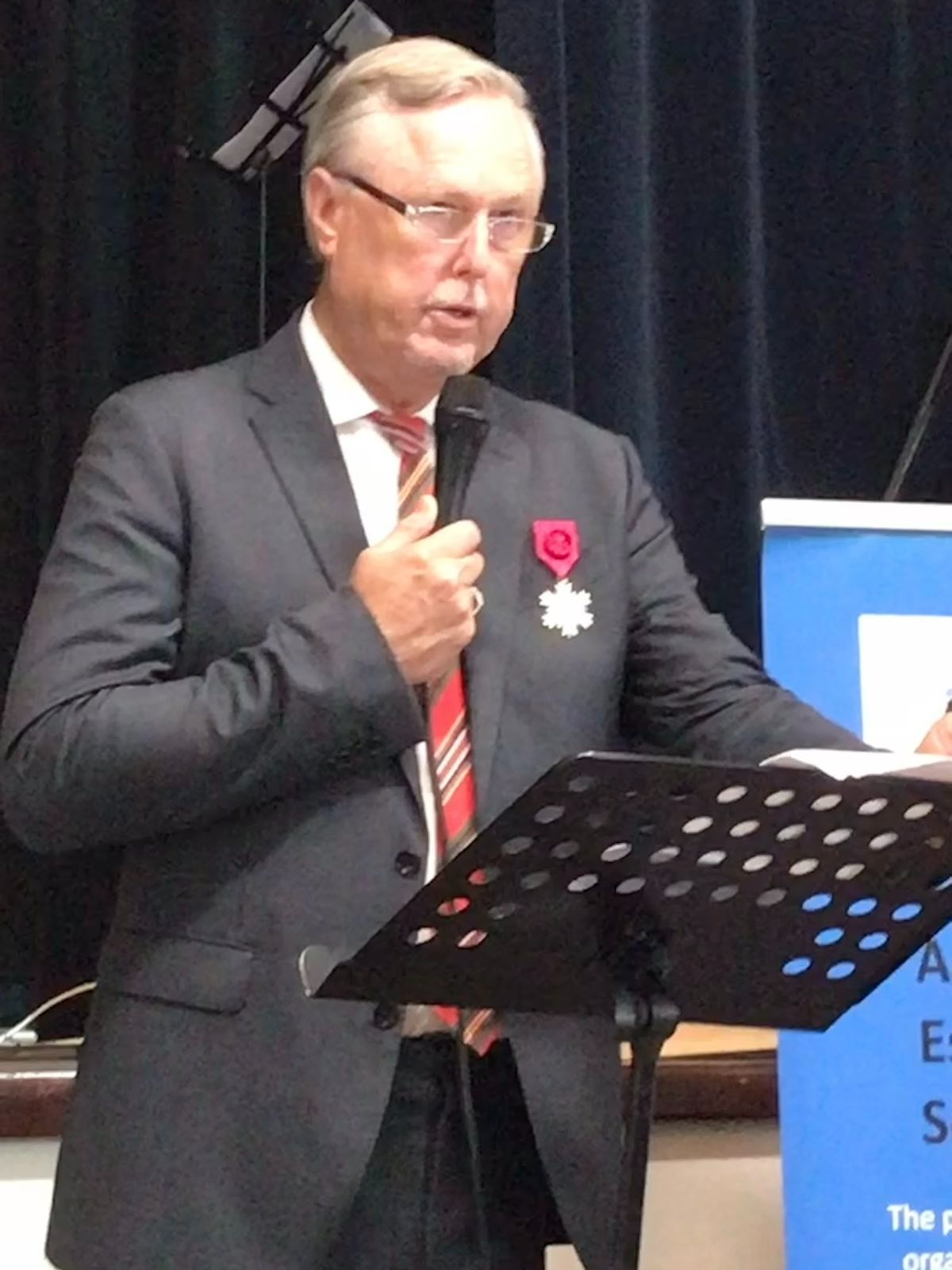
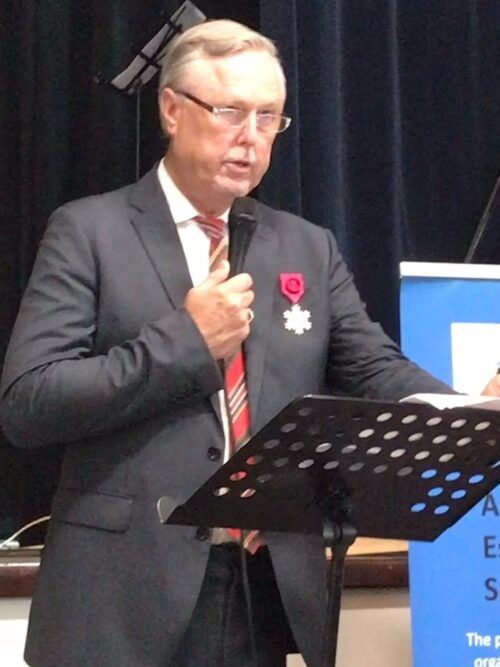
Sulev Kalamäe, Honorary Consul of Estonia at Estonian House Sydney, February 26th, 2023
February 24 is the birth date of the Estonian Declaration of Independence, a birthday celebrated every year since 1918. Over 105 years ago, just after the October 1917 Revolution, the Estonian people commenced a two year long war of independence, to win the right to exist as a sovereign nation.
At the time they faced a new foe, Soviet Russia, which in all respects appeared to be just as imperialistic as the Czarist regime that the Estonian people had lived under for centuries.
Last month also marks 103 years since the signing the Tartu Peace Treaty, whereby Soviet Russia guaranteed to “recognise for perpetuity” the existence of the new Estonian Republic. Of course this treaty was ignored by Moscow, who in 1940 proceeded to occupy and then annex Estonia.
As we know, after five decades of Soviet occupation Estonia finally reclaimed it’s independence in August 1991, during the disintegration of the Soviet Unon. In the 32 years since then, Estonia has developed into a leading modern European society, was accepted into the European Union, and became a full member the NATO defence alliance.
We have much to celebrate!
More recently however, our nation’s birth date of February 24, has developed a second much sader meaning – it now marks the anniversary of last year’s unlawful invasion of Ukraine by the Russian Federation.
There has now been a full year of war in Ukraine. Over a quarter of a million soldiers & civilians on both sides killed and wounded. Some 13 million Ukrainians have been internally displaced or become refugees in neighbouring countries. Such unimaginable horrors and loss of human life and property has not been witnessed on the European continent, since the end of World War II, some eight decades ago.
Despite the disintegration of the Soviet Union and the end of Soviet communism, it is clear that Russia’s mindset towards it’s neighbours has never really changed. The attack on Ukraine is a continuation of the imperialism that Russia has displayed for centuries.
At the risk of saying ‘I told you so’, Estonians have been warning the world about Russia for decades, but until last year such claims were often ignored and dismissed as bordering on paranoia. However, the nations of Europe and the world are now almost unanimous in their condemnation of Russia:
Finnish Prime Minister Marin Sanna said this week that
“Russia poses a threat to all of us and that is why we must help Ukraine win this war’.
Our own President Alar Karis made a statement a few days ago –
“If anyone was thinking Russia is interested in peace any time soon then think again……Moscow’s aims are unchanged, they are ready for a long & hostile confrontation with the West, and will not tolerate dissent. Stalin must have smiled in his grave.”
The Secretary General of the United Nations, Mr Antonio Guterres, has said
“The invasion is an affront to our collective conscience. It is a violation of the United Nations Charter and international law.”
It is highly doubtful however, that such verbal condemnations will sway Russia from it’s chosen path of warfare to achieve it’s imperialistic ambitions. In fact, intelligence organisations are reporting that Russia is now rebuilding it’s army as a top priority, with no financial constraints. Russia’s defence budget for 2023 is already 1/3rd of their national budget.
Russia’s invasion of Ukraine, and the reaction of the world, has caused people to question and try to better understand what they value – both as individuals and as nations. Recent events have forced us to contemplate, not only what kind of a nation we want to live in, but how much worse our lives might be if we don’t stand up for our values, the principles of sovereignty and a rules-based international order.
105 years ago Estonia’s forefathers had to consider the same issues, when they made their fateful decision to fight for their values, their way of life, and to achieve independence and sovereignty for Estonia.
As our Prime Minster Kaja Kallas has said
“Let us ask [ourselves] do we grasp the magnitude of what is happening in Ukraine and what is at stake here? Is our response adequate and what would be the price of failure?”
After twelve months since the invasion, Ukrainians have clearly demonstrated that this war is winnable, but they need continued support. I am proud to note that the Estonian nation has provided the highest amount of humanitarian and military assistance within Europe, on a per capita basis.
By helping Ukraine resist the Russian invasion, we are helping prevent a similar future outcome for Estonia.
If Russia wins in Ukraine, then there is a real possibility that Estonia and the other bordering states may soon become the next targets of Russian imperialism.
So if on Estonia’s birthday we wish to give an effective present to help guarantee the existence of Estonia as a nation, then one of the best ways we can do so, is by continuing to provide assistance to Ukraine.
By ensuring Ukraine’s survival as nation, we are also protecting the future of the Republic of Estonia.
Palju õnne Eesti. Soovin Eesti Vabariigile kaunist sajaviienda sünnipäeva! Elagu Eesti! Slava Ukraini!
Are you curious to discover which of the political parties competing in the 2023 Estonian parliamentary elections best matches your political views and preferences?
What is Valijakompass 2023 and how does it work?
Valijakompass is a Voting Advice Application built, in collaboration with the Estonian broadcasting company ERR, to help citizens make an informed choice in the 2023 Estonian parliamentary elections.
Valijakompass invites users to react to 35 statements covering a wide range of contemporary policy issues and political values in Estonian politics. The results show which parties stand closest to citizens’ preferences, also with the help of visual tools that show where the user and the parties are placed in the Estonian political landscape.
24 February – a most prestigious day for Estonians, the day when we celebrate our declaration of Independence, the formal birth of our nation.
But it is also a time to reflect on the past, with a view to the future.
The name Estonia (Estonian: Eesti) has been connected to Aesti, a people first mentioned by Roman historian Tacitus around 98 AD.
A few moments in our history . . .
1199
In 1199, Pope Innocent III declared a crusade to “defend the Christians of Livonia”. Since those times, Estonia was mainly under the rule of foreign powers.
1199
1850s
The Estonian national awakening began in the 1850’s as several leading figures started promoting an Estonian national identity among the general populace.
1850s
24/02/1918
On 24 February 1918, following the first World war, Estonia declared Independence from the then warring Russian and German Empires.
24/02/1918
28/11/1918
But this was not automatic – on 28 November 1918, Soviet Russia invaded, starting the Estonian War of Independence. Fighting continued for just over a year. On 2 February 1920, the Tartu Peace Treaty was signed by Estonia and Soviet Russia, with the latter pledging to permanently give up all sovereign claims to Estonia. Unfortunately, we know well how little we can trust Russians.
28/11/1918
1920 – 1944
Estonia then existed independently until the soviet Russian invasions starting in 1944.
1920 – 1944
1944-1991
This was a bleak period for us, for close to 50 years, until Independence was again declared in 1991.
1944-1991
Now Estonia is a proud country, well known for punching above its weight in many areas. Technology, start-ups, political thought, childhood education . . .
The first country in the world to have females as both President and Prime Minister; being able to do taxes on-line very quickly, using phones for taxes, travel, etc
So many areas.
And the world has seen us achieve much peacefully – our Laulupidu song festivals are a shining example across the world, as are the dance festivals.
While 24 February is a day of celebration for us, I fear that in history the day will be overshadowed by a major disaster – one year ago, on 24 February 2022, Putin’s Russia declared war and invaded Ukraine.
Some Estonians living in Australia were part of the mass escape from Estonia in the 1940’s. But most of us are here now because our parents or grandparents needed to escape from the Russian hordes and the terrors in Europe. We are probably too young to remember any of that, or to have experienced any of the terrors. But what is happening in Ukraine in the past year is similar to what our parents escaped from.
In 2022, Estonian Prime Minister Kaja Kallas said in a speech prior to the invasion of Ukraine:
“The current situation in Europe resembles the tensions before World War II.”
“Our freedom has never been under such a serious attack in the last thirty years as it is today”
“after restoring our independence, we have raised a generation of young people who take the current organisation of our society for granted.”
I.e. freedom, democracy, and so on
So while we bask in our freedom now, and celebrate Free Estonia, the Ukraine situation should be a reminder to us all that freedom is not given, it needs to be fought for, and then to be protected.
But we can be proud again, that Estonia has supported Ukraine per capita more than any other country. And we are a leading light in the way to strengthen Europe and our allies against this Putinocracy.
One of the major policies coming from Estonia in recent years has been the notion of Global Estonians – of “Estonian-ness”. Estonia sees all of us – emigrants, children of refugees, travellers, backpackers, our families – wherever we are, as being Estonians. And there are many plans and programs to welcome us all.
But this raises the question
What does it mean to “be Estonian”?
Does it mean that we eat Estonian foods?
That we sing Estonian songs?
Do we take part in Estonian singing and dancing?
Should we wear our national costumes to various functions?
Does it mean that we must teach our children to speak the language?
Do we teach them about our history?
So – I ask you – are YOU an Estonian?
Do you FEEL Estonian?
Maie Barrow tells how she was asked how would she know if she were more Estonian or Australian?
She replied that she would not know, until Estonia was playing Australia in the final of the Soccer World Cup, and she then had to decide who to cheer for.
From people I know, or meet – Estonians are a very proud nationality. Perhaps those of us born here feel it more? We were not born there and have not lived there, so perhaps we have a deeper need to connect?
I often notice how many of us feel that we are more Estonian than others, that we feel more deeply. This is not a bad thing, but we all feel differently, according to our own situations and experiences.
The important thing is for us to share our Estonian-ness – whether it be singing, or dancing, or food and drink, the language, or the customs.
Anything at all that helps us to share our heritage with the world.
If we want Estonian-ness to continue and flourish, we need to share it, and pass it on to newer generations.
2023 Aukiri Awardees
One of the pleasant duties for the annual Independence Day is that AESL, the Council of Estonian Societies in Australia (Austraalia Eesti Seltside Liit) awards an Aukiri to people who have served the community at large, making a significant contribution for a period of time (at least ten years).
The 2023 Aukiri awardees are . .
Amelia Tiivas – Adelaide
Steven Buchert – Sydney
Kuno Mikkor – Melbourne
Matti Põldoja – Melbourne
We thank these people for their dedication and their extensive contributions towards promoting and furthering Estonian-ness in Australia.
Congratulations, and Thank You
A quick reminder from Estonia – the federal elections are coming up in the next few weeks, and everyone eligible to vote is asked to please take part, and help shape our nation’s future.
Dear Estonians in Australia, AESL wishes you joyful Independence Day celebrations and success in enterprises that take will take us to the future. Happy Independence Day!
Long live Free Estonia! Elagu Vaba Eesti! 24 February 2023 Dr Juho Looveer President, AESL
Eesti Vabariigi iseseisvuspäeva aktus | Estonian Independence Day
February 26 @ 2:00 pm – 4:00 pm
The Estonian Society of Sydney invites you to join us at Estonian House in commemorating the Independence Day of the Republic of Estonia, an important national holiday marking 105 years since the declaration of statehood on 24 February, 1918.
PROGRAM: A reception of singing from our Australian-Estonian national choir “Kooskõlas” and solo performers, folk dancing by our local performers from “Virmalised” will be held with complimentary food and tea. A curated exhibition of artworks exploring topics of national identity will also be on display in the front foyer.
There is no better day for wearing your folk costumes with pride!
This year the celebration of Vabariigi Aastapäev – Independence Day – will be held at the property of Lembit Marder, our Honorary Consul, at Kyneton. It will be on SATURDAY, 25th February 2023, starting at 12:00 for lunch. A sausage sizzle will be provided at no cost; or if you would rather, bring a picnic lunch. A BBQ will be available. BYO drinks.
Don’t forget to bring a chair, a rug, sunscreen, Aeroguard and a hat. Plenty of on-street parking. A great opportunity to get out of town and enjoy the air and views. Let your friends and family know that the event is on, with a new venue. Unfortunately there will be no bus running, as there weren’t enough people requiring the service.
LOCATION: Estonian Consulate, 121 Bald Hill Rd. Kyneton RSVP to Bernadette melbourneestoniansociety@gmail.com if you intend coming along so we have an idea for catering.
February 2nd is the anniversary of the Tartu Peace Treaty.
It is an important day for Estonians, but also for international communities.
As the Ministry of Foreign Affairs pointed out: “Estonia’s peace treaty with Russia was the first international act that mentioned the right of peoples to decide their own destiny. Therefore, the Treaty of Tartu – as well as other treaties between Russia and its western neighbours that were modelled on it – constituted an important step towards enshrining the nations’ right to self-determination in international law.”
Our annual commemoration of the Tartu Peace Treaty gives pause to reflect on Estonian history, the lives lost in pursuit of freedom, and to appreciate our national and international dignity.
It remembers the birth of a bright nation, after 700 years of waiting. It serves as a reminder for how challenging, yet possible, the journey towards peace is. It marks a day of reflection for the vital quest for autonomy – the right to try, despite flaws and struggles; the free choice and ability to determine one’s own course of action and fate, without external compulsion.
Turbulent times followed in the decades after the peace treaty, and questions to the right of self-determination have again risen in current international politics.
While the course of the future remains unknown, Estonian memories and values are not forgotten. Together, let’s take a moment to remember the journey and significance of the Tartu Peace Treaty.
The birth of a nation – a brief history
On the heels of World War I, trouble continued to stir in the East.
Aboard the Imperial train, about 20 km east of Estonia in Pskov, Tsar Nicholas II abdicated the throne. The Russian Empire had collapsed. The new Russian Provisional Government took over, and in April 1917, declared the autonomous Governorate of Estonia. A series of elections in Estonia followed to form a provincial assembly, colloquially known as Maapäev. This process saw the creation and reorganisation of Estonian national parties, altogether forming a 62 seat assembly with representatives for towns, rural communities, the Baltic German and Swedish-Estonian minorities, and independents.
Then, the October Revolution happened. In mid-November 1917, the Bolsheviks, led by Vladimir Lenin, overthrew the Russian Provisional Government and established the world’s first Communist government. Lenin issued the Decree On Peace which called for the immediate end to the War on the basis of a “just and democratic peace”, which was defined as “a peace without annexations or indemnities”; national self-determination in place of the traditional power politics, and the end of secret diplomacy.
In the wake of the revolution, Maapäev refused to recognize the new Bolshevik rule. Instead, Maapäev declared itself the supreme legal authority of Estonia until the convening of the Constituent Assembly. Eleven days later, the bolsheviks dissolved Maapäev by force and drove pro-independence Estonians underground.
In early 1918, the Bolsheviks themselves organised the Constituent Assembly elections in Estonia. Two-thirds of the voters supported the parties who stood for national statehood. Subsequently, the Bolsheviks proclaimed the elections null and void.
Shortly later, using the interval between the Red Army’s retreat and the arrival of the Imperial German Army, Maapäev formed a three-member committee with special powers for a special purpose. On the eve of the German occupation of Estonia, 24 February 1918, this committee issued the Estonian Declaration of Independence and established the Estonian Provisional Government.
Alas, the day-old Estonian government was not recognised, and the occupying German authorities made arrests. In March, the Treaty of Brest-Litovsk was signed between Russia and the Central Powers (Germany, Austria-Hungary, Bulgaria, and the Ottoman Empire), ending Russia’s participation in the Great War and their claim over Estonia. But, WWI was soon coming to an end, leading to yet another opportunity.
Germany was struck by revolt which spread across the Empire within days. The German Revolution led to the proclamation of a republic in early November 1918, shortly thereafter to the abdication of Kaiser Wilhelm II, and to German surrender. In Estonia, German authorities eventually gave over all political power to the Estonian Provisional Government, albeit falling short on recognizing Estonian independence. The newly established Estonian Police took over power from German forces in Tallinn, new national armies were formed, and mobilisation occurred across the country.
Meanwhile in Russia, plans were drawn to launch a wide westward offensive from the Gulf of Finland to Ukraine, to reconquer lost nations. The bolsheviks had annulled the Treaty of Brest-Litovsk after the German surrender. Approaching the dawn of winter, on 28 November 1918, the red army sieged Estonian territory, instigating the Estonian War of Independence.
Watch an animation of the War of Independence:
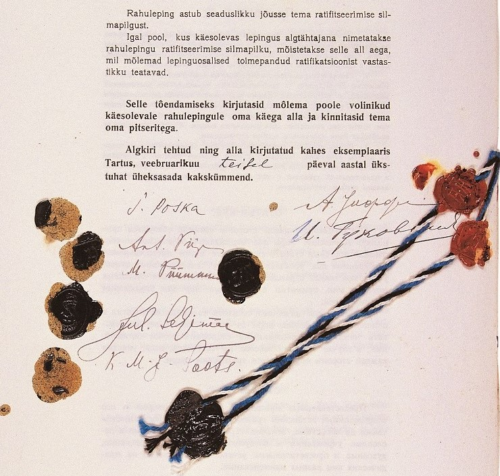
Fending off attacks from both bolshevik Russia and Germans for over a year, the Estonian War of Independence finally came to an end on 2 February 1920 with the Treaty of Tartu. Borders were drawn, policies were decided; an agreement to end the state of war was reached, finally signed with a blue-black-white string affixed on top by wax.
With the treaty, Russia recognised Estonia’s independence for an eternal time forever de jure, voluntarily and forever withdrawing from all sovereign rights that Russia had had for the people and land of Estonia.
Jaan Poska, the Estonian statesman who led the Estonian delegation, said after the signing: “Today is the most important day of the past 700 years for Estonia, because today, for the first time, Estonia alone will determine the future fate of its people”.
People gathered in the streets to greet the Estonian delegation, taking their hats off in respect despite the bitter cold. A woman told Jaan: “You saved our sons”.
In reflection nearly 70 years later, a 1995 Eesti Päevaleht article aptly called the Treaty of Tartu: “Estonia’s birth certificate”. Russia recognised Estonia in law, paving the way for Estonia’s international recognition as a free and independent country. Likewise, the Treaty of Tartu was also the first international act recognising the Soviet government.
In a statement on the 100th anniversary of the Tartu Peace Treaty, the Estonian foreign minister, Urmas Reinsalu, emphasised the “pioneering significance” of the treaty in the global system of international law, since “it was the first international act in the world that explicitly cited the concept of the peoples’ right to self-determination”.
Today, while the Republic of Estonia has restored its independence, the concept and battle for the right to self-determination continues at home and abroad.
Commemorating the Tartu Peace Treaty
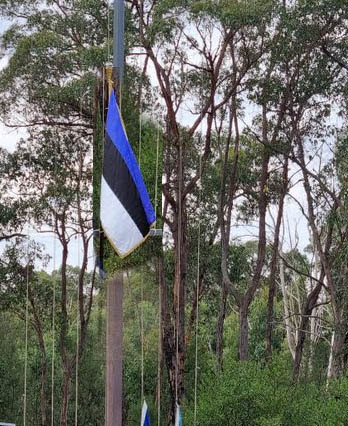
In Estonia, the anniversary of the Tartu Peace Treaty (02.02) is a Flag Day. The government and local authority agencies and legal persons in public law hoist the Estonian flag at sunrise and lower it at sunset.
A number of ceremonies take place across the country, including placing wreaths on the War of Independence memorial and the grave of freedom fighter Julius Kuperjanov, and lighting candles at the bas-relief depicting Jaan Poska.
Estonian embassies around the world have their own traditions too. For example, the Embassy of Estonia in Moscow, traditionally places a candle on the grave of Adolph Joffe, who signed the peace treaty on behalf of Soviet Russia, to commemorate “all those who sacrificed the most important thing in their lives for Estonia’s freedom and independence – their life itself”.
As an Australian Estonian, how will you decide to commemorate the anniversary of the Tartu Peace Treaty? What are your reflections of this historical moment?
The Ministry of Foreign Affairs of Estonia and the National Foundation of Civil Society invite young Estonians living abroad to apply for a scholarship to complete a professional internship in Estonia.
The purpose of the scholarship program is to facilitate the integration of young people living abroad into Estonian social life.
The scholarship consists of a basic scholarship and, if necessary, a travel scholarship. The basic stipend is intended for a full-time internship during two months (or a minimum of 8 weeks), which is paid once and is 3,000 euros. If necessary, a travel stipend is also paid for one trip from the place of residence in a foreign country (location and address given in the application) to Estonia and back.
The scholarship application deadline is April 24, 2023 at 3:00 p.m. (Estonian time).