SPEECH ON 106TH ANNIVERSARY OF ESTONIA’S INDEPENDENCE Sydney Estonian House Sulev Kalamäe, Honorary Consul of Estonia, Sydney
Kallid Eestlased ja austatud külalised! Dear Estonians and our distinguished guests. Happy 106th Anniversary of Estonian Independence Day! Elagu Eesti Vabariik!
As we are all aware, February 24 is the birth date of the Estonian Declaration of Independence, a birthday celebrated every year since 1918, when, just after the October Revolution of 1917, the Estonian people commenced a two year long war of independence, to win the right to exist as a sovereign nation.
Our ancestors fought hard and eventually won this battle against the Russians and the Germans over a century ago. However I’m now conscious of two subsequent and sad historical twists:
The first is, that by the time construction of the new Sydney Estonian House hall was finished in mid 1940 and Independence Day was first celebrated within these walls 83 years ago on 24 February 1941, by that time Soviet troops already had rolled into Estonia in the previous June 1940, to begin another 50 years of occupation. It was not until 1991, that our local Sydney Estonian community could once again celebrate the existence of a truly free and independent Estonia within this hall.
Secondly, our nation’s happy birthday date of February 24, has now a second much sader significance – this year today now marks the second anniversary of the unlawful invasion of Ukraine by the Russians. The attack on Ukraine is a continuation of the imperialism that Russia has displayed for centuries. Despite the disintegration of the Soviet Union and the end of Soviet communism in 1991, it is now obvious to the world that Russia’s mindset towards it’s neighbours has never fundamentally changed.
One consequence of Russia’s invasion of Ukraine is that it has caused people in Estonia, people here in Australia, many people here in this very hall – to question and try to better understand what they truly value – both as individuals, and as nations. Recent events in Ukraine and the Middle East have forced us – as fellow human brings, as husband and wives, as mums and dads – to contemplate, not only what kind of a nation we want to live in, but how much worse our lives might be – if we don’t stand up for our values, stand up for the principles of sovereignty and preserve a rules-based international order.
106 years ago today Estonia’s forefathers had to consider these very same issues, when they made their fateful decision to declare their independence as a nation, and fight for their values, their way of life – to achieve independence and sovereignty. Today we salute them for their vision, their principles and their courage!
Nüüd pakkun teile kõik siin täna, pits viina EV terviseks. Kas klaasid on täis?
Palju õnne Eesti Vabariik!
Elagu Eesti!
Second Speech
Like probably some of you within this room may already have done – I have recently been going through my late father’s possessions including boxes of memorbillia from WWII and his first years in Australia.
He has kept many personal items that meant a lot to him, including a beautiful expensive book on Harald Nügiseks a great Estonian war of WWII, whom he greatly admired.
Here I am looking at this book and asking, myself – shall I keep it, or shall I throw it out?
For my my children and grandchildren, don’t know who Nugiseks was, the book has no relevance to them. Even though he fought and lived passionately, and risked his life for Estonia, they are in all fairness oblivious to this man. They would probably be more interested in a book about someone more modern, like Taylor Swift, and even then, they probably don’t even really appreciate printed books – most of today’s body of knowledge is virtual and all resides in the internet.
Why I am bringing this matter up, is that for me, I think this is a perfect example of as how time marches on, and what is important, critical, vital, essential to one generation, is often gradually diluted, become irrelevant and eventually forgotten one or two generations alltogether.
So in short the beautiful book on Nugiseks is probably eventually going to the tip.
It’s sad how time as it marches on is generally not kind to the past, we humans are naturally far more interested in the present, our immediate surroundings, and current political events. Things that effect our present well-being and prosperity and happiness.
But on occasions like today, we need to be reminded about the past to reflect on our current situation, and ultimately our future.
We need to remember and honour those who have gone before us.
Particularly those who have made the ultimate sacrifice.
Today I would like to remember and honour Konstatin Pats.
Today I would like to remember and honour our fathers and mothers, grandmothers and grandfathers who lived through the most turbulent ja horrific times during WWII and made the post war migration to this lovely continent.
I respect the hard work they put in to create this Estonian Community we have here in Sydney. This Estonian House did not somehow miraculiulosly appear of it’s own volition. Decades ago people – just like you and me, but now long deceased – put their hand in their wallets and volunteered their services to build this house and create the Eest Selts we now have. As others before you have done all the hard work – you are now enjoying the physical benefits of their love of Estonia and all things Estonian.
But I digress. Whilst I stand here and romaticise about the past, there is one other person in this world who also has a tremendous respect and yearning for the past – namely Valdimir Putin. He pines for the glory of the former Soviet Union and of the old Czarist Russian Empire. By launching a full-scale attack on the independent soverign nation of Ukraine two years ago today, this man has up-ended the rules-based world order a half century of relative peace and caused Europe to embark on the biggest rearmanent program since WWII.
Estonia now faces the biggest security threat to it’s existence, since reindependence was acheived in 1991. Sadly it is not just Putin who thinks this way, the majority of the Russian population seems to have drunk from the same well of imperialistic lust, they seek to restore their hegemony over Easterm Europe and the Baltic States.
So far Estonia is lucky that we are not only in the European Union, but also in NATO. This has probably saved us from the same fate as Ukraine.
But nothing is certain anymore, we live in troubled times with a United States more internally divided than ever, and thus casting potential questions over it’s future strategic assistance to Europe, should the Russian Federation ever invade.
I believe that during the next twelve months, the outcome of the US elections will probably bring some clarity in one way or another.
In the meantime we must pray that Estonia continues to be lead by strong leaders like Kaja Kallas, who the press are apparently loving, and labelling as the new Iron Lady of Europe.
As our Prime Minster Kaja Kallas has said
“Let us ask [ourselves] do we grasp the magnitude of what is happening in Ukraine and what is at stake here? Is our response adequate, and what indeed would be the price of failure?”
Estonian Prime Minster Kaja Kallas
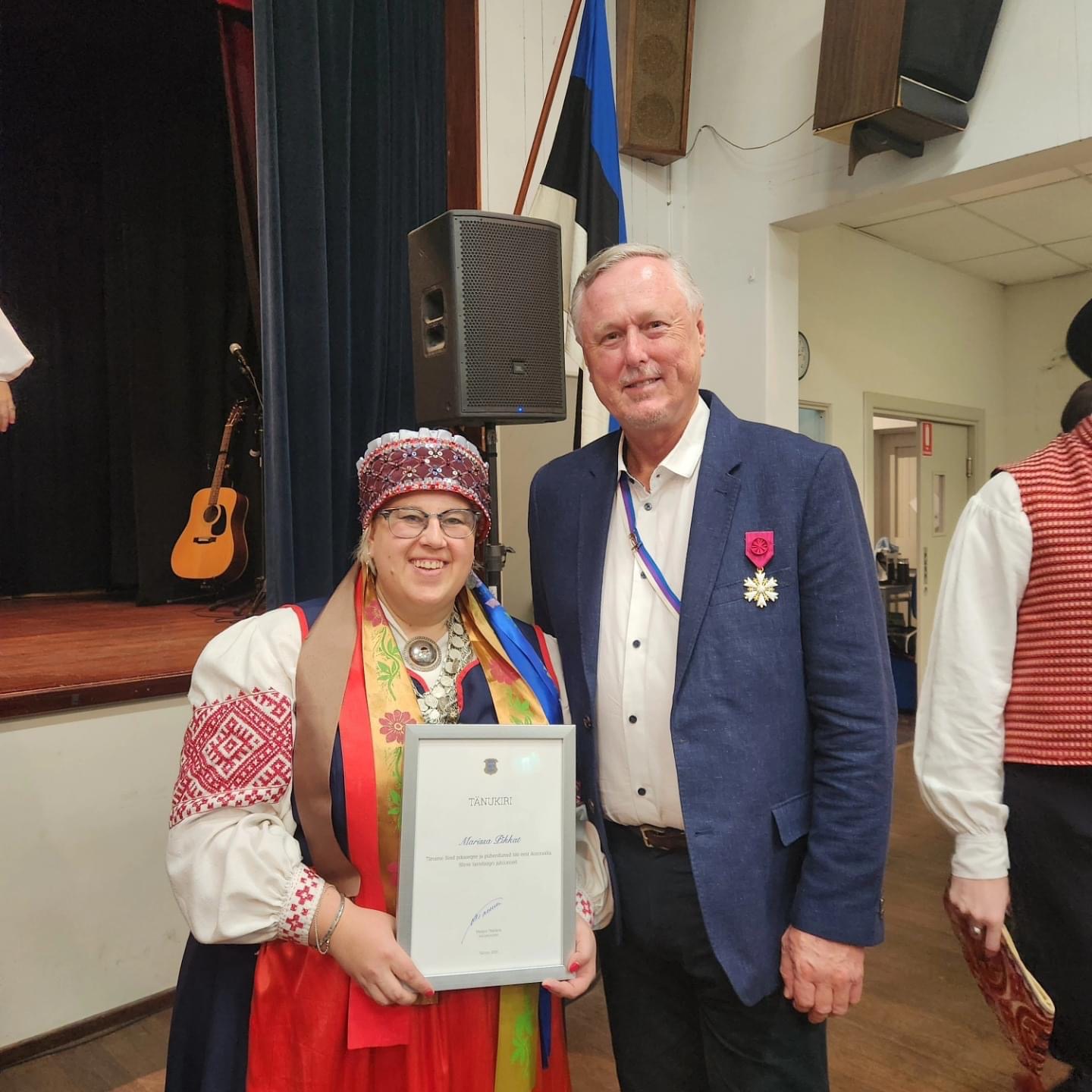
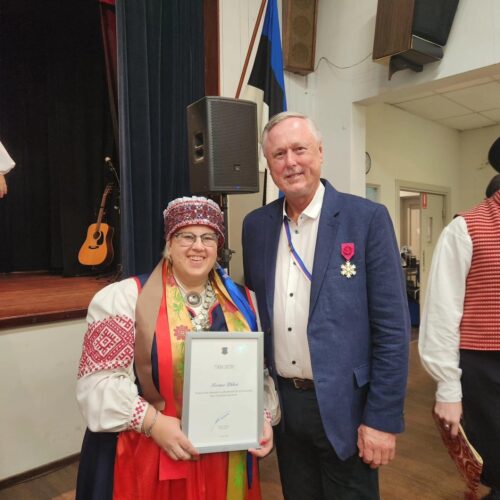
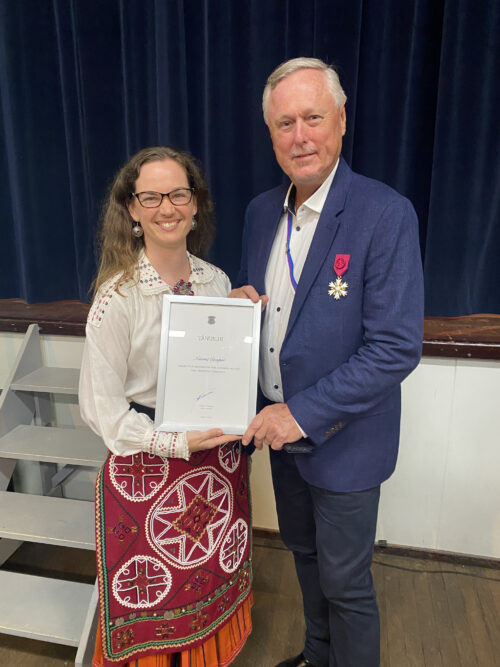
Sulev Kalamäe presents Letters of Appreciation from the Foreign Minister of Estonia
Marriss Pikkat and Sulev Kalamäe
Naomi Cooper with Sulev Kalamäe
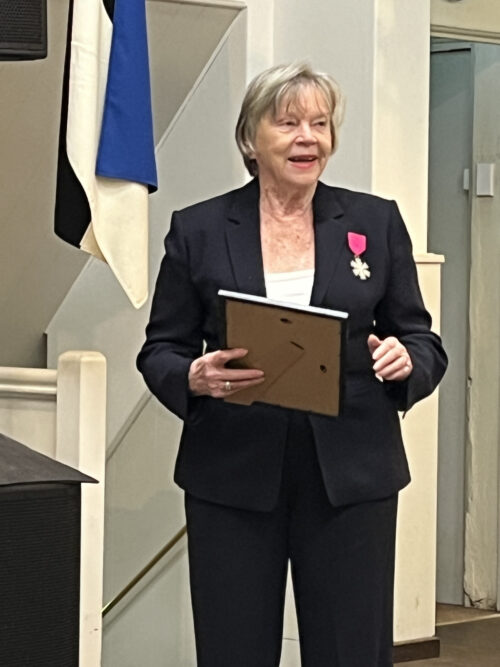
Maie Barrow accepts the award on behalf of the Estonian Archives in Australia
📣 We’re experimenting with a new news format for everything Estonian in Australia! You’ll find a summary of national and local community stories from this past month, as well as events coming up next month. What do you think? We’d love your feedback: contact us.
Have news to share? Write to us: news [at] eesti.org.au
This month in Australia
Key National Insights:
This month we celebrated the Republic of Estonia’s 106th birthday.
AESL recognised five individuals, presenting 2024’s Thank You’s to Andres Truus (QLD), Martin Kurvits (SA), and Leo Adamson (VIC), as well as Lifetime Achievement Awards to Tiiu Salasoo (NSW) and Maie Barrow (NSW).
Eesti.org.au initiated the Australian Estonian Media Project, seeking volunteers to join. The Media Project also published their national survey and workshop results.
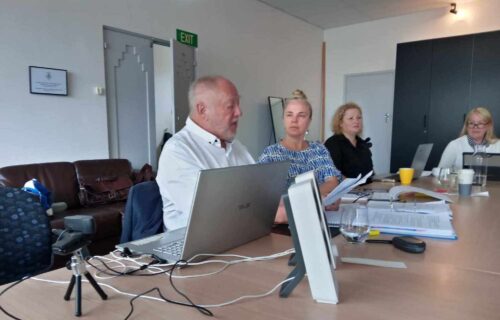
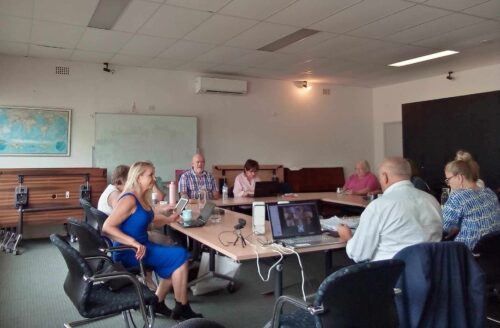
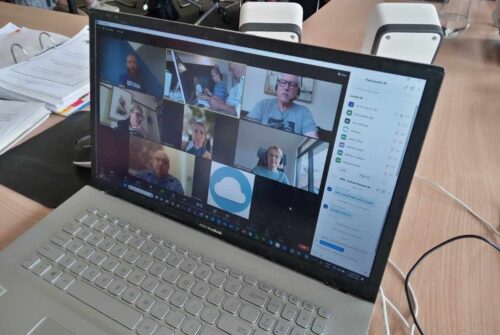
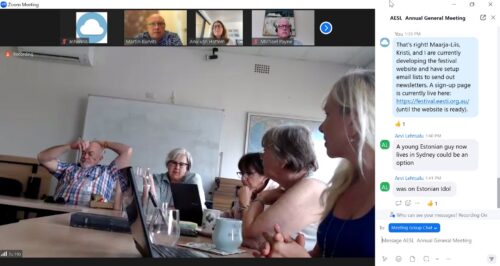
The AESL AGM was held in January 2024, attended by 21 people, annual reports were presented and discussed, many matters were brought up.
Attendees were most interested in upcoming Eesti Päevad and media developments, but also generally where the Estonianism in Australia is headed, and how, in what way. Cities and their organisations have different ways to attract new people, ideas were exchanged at the meeting, now more and improved visibility is needed both from city organisations and AESL so the ways and thoughts reach wider audience.
AESL is a closed environment no more, times are changing. It is not only old generation leaving the stage but also the ’middle’ generation’s readiness to hand over to youngers. It is a new place where we are headed and this takes everyone’s thoughts. Next such opportunity will be at Adelaide Eesti Päevad that is held 70 years from the first Eesti Päevad in Australia. AESL will invite Eesti Päevad attendees to ’unconference’ – where rather than speeches, speaking of minds is encouraged.
– Sirje Rivers
Feb in WA
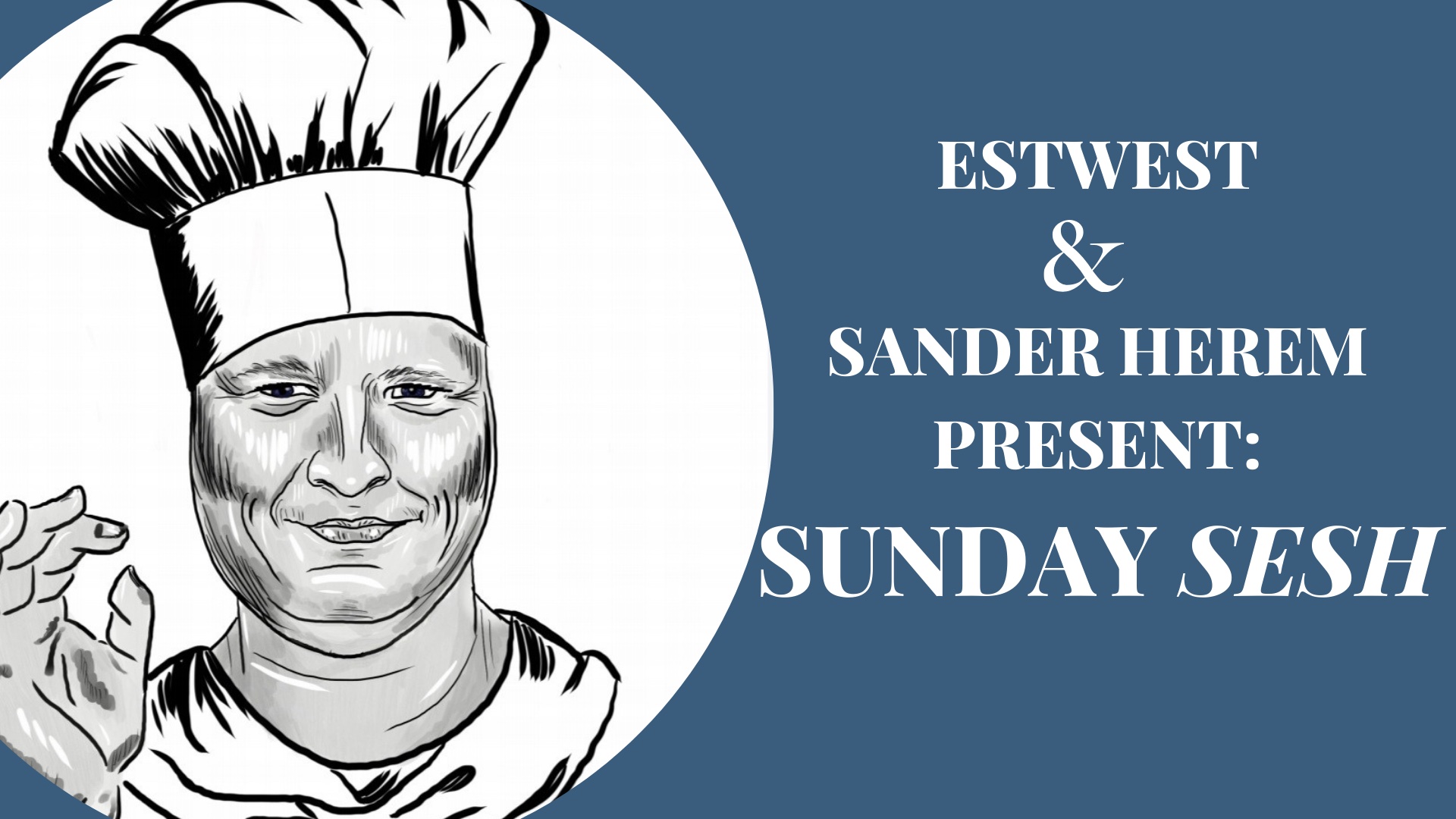
Western Australia is the home of a new cultural hub, EstWest. On the 25th, EstWest hosted its first “Sunday Sesh”, featuring Estonian comedian Sander Õigus. Sander also performed his new act “Vertikaalne Lõpmatus” on Independence Day.
The Honorary consul, Anu van Hattem, held the third annual “Family Insights Series” to commemorate Estonia’s independence; read “Gert by Sea” for this year’s edition.
Feb in VIC
Following his shows in Perth, comedian Sander Õigus performed “Vertikaalne Lõpmatus” at Melbourne Estonian House on the 26th. Interview with Sander coming soon.
Feb in NSW
Sydney Estonian Society celebrated Independence Day with speeches, performances, and refreshments. To celebrate our heritage, culture and community, Sydney Virmalised released six recordings of their favourite dances.
The Archives offers new trading hours on Thursdays, with Terry Kass at the helm as Honorary Archivist.
Feb in SA
In South Australia, Vikerkaar and Hapukoor performed for Independence Day; light afternoon tea of sandwiches, cake, and coffee was served. Estonian singer Mari Kalkun will be giving workshops at WOMADelaide in March 2024.
Feb in TAS
The Tasmanian Estonian Association held its combined AGM and barbecue on Independence day near Hobart.
Please get in touch by emailing news [at] eesti.org.au
We are striving to improve communications among Estonian communities in Australia so that everybody can have the opportunity to share and hear about news and events.
Ultimately, the community gets what the community gives – we are humbly asking for your support. If there are events or news you know about, please reach out to us.
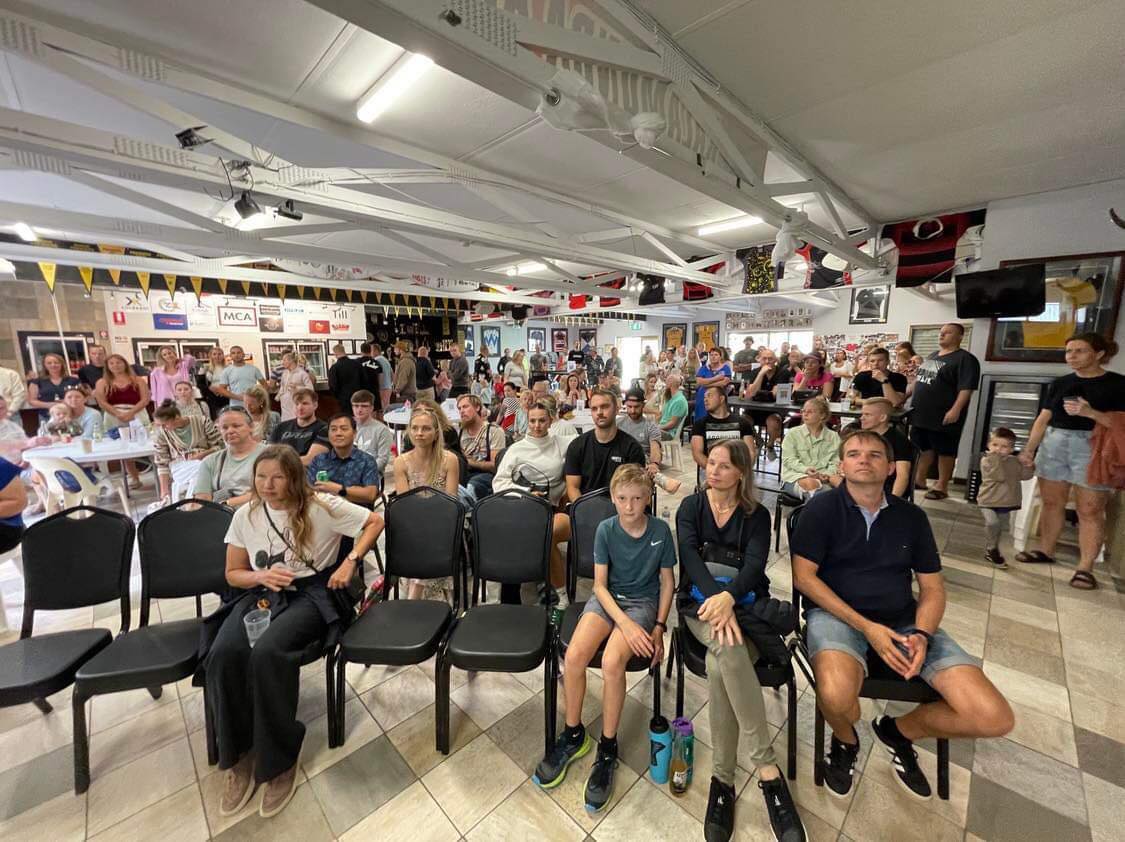
What an incredible turnout on Sunday, everyone! It was an absolute delight to welcome nearly 200 members of the Estonian community, both big and small, as well as Estonian enthusiasts.
We just want to extend our heartfelt thanks to each and every one of you for joining Sander Õigus, EstWest, and our fellow community members at Sunday Sesh. We hope you had a fantastic time and will consider becoming regular guests at our monthly Sunday Sessions.
When we first started planning our inaugural event as EstWest just 10 days ago, we had barely submitted our association registration paperwork, didn’t have a Facebook page, a fully functioning website, or even a logo (which we still don’t have), but we did have an incredibly dedicated core team and a strong belief that where there’s a will, there’s a way!
Just a few days before the event, we were thrilled to receive our official registration! Despite officials stating a wait time of 2 months, we managed to obtain our registration in just 2 weeks.
Our ambitions are significant – we aim to establish our own Eesti Maja here in WA, a place where everyone is welcome and where a slice of Estonian culture can thrive in the wider world.
EstWest has numerous goals, but our primary objective is to foster a stronger and more connected Estonian community.
We’re committed to transparency regarding the sources of our donations and how they will be utilized. Therefore, we’ll provide another report on this matter once all costs have been thoroughly calculated.
Additionally, we value your input. Whether it’s identifying areas for improvement, suggesting ways to enhance our offerings or simply offering a helping hand as we’re all volunteers here on the committee, we greatly appreciate your involvement.
“Head iseseisvuspäeva! Happy Independence Day Estonia!”
The year 2024 marks the 90th anniversary of the 1st Üldtantsupidu (Estonian Dance Festival) held June 15–17, 1934 and the 90th anniversary of the first documented performance of Estonian folk dancing in Australia in Sydney.
To celebrate our heritage, culture and community Sydney Virmalised have released six recordings of our favourite dances on the 106th Anniversary of the Independence of Estonia.
These videos are not only a public resource for anyone to use when rehearsing but form a snapshot and archive of our activities in Australia in 2024. As we put in our bid to perform at Tantsupidu in 2025 we hope to record more of our dances and make them available to the public!
These videos were performed on Wangal Country at Latvian House, Strathfield with filming and editing by Liam Black. We thank the Sidnejas Latviešu Biedrība / Sydney Latvian Society for allowing us to use their hall for recording.
Thankyou to all of our dedicated dancers Taimi Maidla, Tiit Simonlaster, Rachel Matwisyk, Warwick King, Jana Mõisa-King, Andrew Kass, Ella Scott, Ximonie Clark, Rhys Maidla, Esmee Okamoto, Lachlan Bell, Marissa Pikkat, Felix Parker and Charlotte Boyd and we hope to keep expanding our team and repertoire. Elagu eesti!
EstWest admits our current visual branding might not be up to the standard, but we’re excited to change that! We’re inviting the community to help shape our association’s identity through this logo design competition.
Association’s mission
EstWest is dedicated to preserving and representing Estonia’s rich cultural heritage. Our mission is to create a vibrant and inclusive space that celebrates Estonian culture and traditions, welcoming Estonians, their descendants, and anyone interested in cultural exploration. We strive to collaborate with diverse communities, governments, and organisations to contribute to the well-being of future generations in Western Australia.
Competition Guidelines
Theme The logo should reflect the essence of Estonian cultural heritage while also embodying the spirit of collaboration, inclusivity, and dynamism.
Eligibility The competition is open to designers, artists, and enthusiasts worldwide who are passionate about Estonian culture and heritage preservation.
Submission Requirements • Submissions must be original creations. • Designs should be versatile, scalable, and suitable for various applications (e.g., digital, print, merchandise). • Each participant can submit up to three entries. • Entries must be submitted in a high-resolution digital format (JPEG, PNG, or PDF).
Submission Deadline: 1.04.2024
Judging Criteria: • Creativity and Originality • Relevance to the theme and mission of EstWest • Aesthetic Appeal and Visual Impact • Versatility and Adaptability
Prizes • Excitingly, we’ll be awarding fantastic Estonian gift hampers to the top three selected entries. The top three entries will be determined through a combination of public voting and evaluation by the association committee.
How to Submit: • Send your logo designs as attachments to ecawa.org@gmail.com • Include your name, contact information, and a brief description of your inspiration behind the design in the body of the email.
Ownership and Usage Rights: • By submitting an entry, participants grant EstWest the right to use the submitted logos for promotional and operational purposes. • The winning design will become the property of EstWest, with the designer credited whenever suitable.
Announcement of Winners: • Winners will be notified via email and announced on EstWest’s official website and social media platforms. • Additional Information: For inquiries or further details, contact ecawa.org (at) gmail.com
Let’s dive into creativity and create something extraordinary! Together, we’ll make magic happen!
The 24th of February 1918 is commemorated by Estonians as the day that Independence was declared. But a declaration on its own does not a nation state make.
What followed was the Estonian War of Independence in which Estonians pushed back advancing Soviets in a legendary David vs Goliath encounter. Accordingly, it is apt that Estonians in Western Australia gathered on Independence Day, 2024, to celebrate of the life of a man that was wounded fighting for an Independent Estonia in 1919. However, its was not Gert Sellheim’s contribution with rifle in Estonia, but pen in Australia, that drew Perth based Estonians to the WA Honorary Consul’s (Anu Van Hattem) residence in Claremont.
Gert’s son, Nik Sellheim, recounted to the attendees how a new Estonian adapted to a land that was as akin to northern Europe as Pluto is to the Sun. Gert arrived in Fremantle in 1926 after leaving Post War Germany. (Gert was an unknowing trail blazer for the many that came in the late forties after Europe decided the tragedy of war was worthy of a sequel).
Nik observed that despite the challenges thrown at Gert, from being indentured on a farm in Pingelly through to being interred as a foreign alien during WW2, Gert embraced Australia as an exciting and modern country and continued to pursue his work in design which eventually became renowned for its aesthetic depiction of Australian culture.
It is curious that an Estonian born, German educated, woollen suit wearing new arrival could emphatically capture the essence of Australia with relatively simple applications of colour and shape. However, the stark contrast of Australian life compared to Europe, from surf beaches to Aboriginal art, perhaps allowed Gert to see the extraordinary in the otherwise familiar. Without being tied to Australian norms and tradition, he took common imagery and applied repetition and geometric composition to form motifs that reflected Australia back to its citizens with a fresh and exotic vibrance.
But Gert’s influence did not stop at the borders of the Island Continent. In addition to many promotional posters used to entice travellers to his newly adopted country to the world, Gert’s most prominent work was for QANTAS – the ubiquitous ‘Flying Kangaroo’ logo. Since cropped of its wings and streamlined (is it truly flying now?) the big red boomer still emblazoned on the back of Boeings and Airbuses is not just symbolic of an airline, but of Australia itself. Many an Australian, whilst taxiing through a far flung airport and chancing upon a QANTAS tail fin scything through the apron traffic, has felt a sense of connection and comfort knowing they are only a single flight from home.
Recognising Gert’s contribution to the Australian visual lexicon, Australia Post has just released a series of stamps replicating some of his travel poster designs, which due to the poster’s planned ephemerality, are increasingly difficult to see in their original form.
Gert Sellheim, along with many other Estonian Australians, contributed to the spirit of Australia as much as Australia contributed to his. Although Nik expressed bemusement of his own lack of creativity, it was pleasing to hear that Gert’s grandson, Berndt, has forged a career in literature and photography, and his great granddaughter is never happier than when up to her ears in paint. May the spirit of Gert continue…
Generally, it is a great occasion for most people. Probably the most celebrated day every year. For many of us, a day we look forward to.
Think back to one of your best birthdays – what was it like? I would guess you had friends and family around you; food; drinks, of course. Maybe some singing and dancing. And isn’t that what we have here? Because today, 24th February, we celebrate the Birthday for Estonia.
In 1918, it was a day of much joy, to officially be proclaimed a country in our own right; to stand on the world stage with other independent countries, quite rightly very proud of ourselves.
And so, we SHOULD celebrate this day each year.
However, when we celebrate our birthday, we also need to look back on our past, how we got here…
Dr Juho Looveer, AESL President, at the Estonian Independence Day Celebrations in Sydney February 24th, 2024
For Estonia, this includes centuries of being under other powers
Starting with the Northern Crusades, Estonia became a battleground of foreign powers from the 13th century onwards. Denmark, Germany, Russia, Sweden and Poland fought their many wars over controlling the important geographical position as a gateway between the East and the West.
Being first conquered by Danes and Germans in 1227, Estonia was subsequently ruled by Denmark, by Baltic German ecclesiastical states of the Holy Roman Empire, and by Sweden. After Sweden lost to Russia in the Great Northern War in 1710, Russian rule was imposed on Estonia. However, the legal system, the Lutheran church, the local and town governments, and education remained mostly German-influenced until the late 19th century and partially until 1918.
Historians talk about the Estophile enlightenment period (1750–1840)
German immigrants and local Baltic Germans in Estonia, educated at German universities, introduced Enlightenment ideas of rational thinking, ideas that propagated freedom of thinking and brotherhood and equality.
The National awakening
A cultural movement sprang forth to adopt the use of Estonian as the language of instruction in schools, all-Estonian song festivals were held regularly after 1869, and a national literature in Estonian developed. Kalevipoeg, Estonia’s national epic, was published in 1861 in both Estonian and German.
Some of the first national newspapers were published by Johann Voldemar Jannsen – who was the father of Lydia Koidula; he wrote the words of the patriotic song “Mu isamaa, mu õnn ja rõõm”, which later became the national anthem of Estonia.
As the leader of the choral society which organised the first nationwide Song Festival in Tartu in 1869, Jannsen played a crucial role in the Estonian National Awakening.
Despite having our Estonian songs banned at different times, gradually our persistence prevailed and a tradition was born.
His daughter Lydia Koidula took over as the main writer and the editor for the newspapers her father had started. She is so well known for her poetry, her stories.
The 1917 Russian revolution and the generally unstable situation in Russia created the opportunity for Estonia to gain its independence. The impetus for independence was provided by the National Front, Estonia’s main ideological movement, which based its ideas on US president Woodrow Wilson’s principle of self-determination.
War of Independence
The Estonian Declaration of Independence was published in the capital city Tallinn on 24 February 1918, establishing the Republic of Estonia.
This led to the establishment of our own government, framing our own Constitution; developing our own independent country. On 5–7 April 1919 the Estonian Constituent Assembly was elected.
A military invasion by the Red Army followed a few days later, however, marking the beginning of the Estonian War of Independence (1918–1920). The Estonian army cleared the entire territory of Estonia of the Red Army by February 1919. and signed the Tartu Peace Treaty with Soviet Russia on 2 February 1920.
On 2 February 2020, marking the 100th anniversary of the Tartu treaty, Urmas Reinsalu, the then Estonian foreign minister, said: “The Tartu Peace Treaty had a pioneering significance in the global system of international law because it was the first international act in the world that explicitly cited the concept of the peoples’ right to self-determination.” This was the precedent for similar treaties with Latvia, Lithuania, Finland, and others.
“Pity that Russia only respected this for about 20 years! And then we had the black years under the soviet Russians!”
Many of us are here because our parents, grandparents or other relatives fled the Russian purges and the great war in the 1940’s. Many Estonians fled to Sweden, Canada, and other countries. After two world wars centred in Europe, Australia seemed to be the furthest away from such tensions, and possibly the safest place on earth.
This mass escape is an important time to be remembered.
The 80th anniversary of the mass escape will be commemorated in Pärnu around the 19th – 21st September 2024. Four days are being planned around that date, with the support of the Estonian government. There had been some resentment in Estonia about the people who fled, leaving others to live under the slavery and the passive genocide by the soviets. So while we may all feel very Estonian and connected to our motherland, we need many people from around the world to join in this event, either in person or virtually, and to clearly demonstrate to those In Eesti that we descendants still have strong ties to our mother country.
In August we will again celebrate our re-independence.
We owe thanks for this re-independence to not only the people in Eesti, but also the many activists in many countries across the globe.
But we can NOT be complacent. Indeed, if we look at the current Estonia, they are not complacent there – in fact, they are looked up to as leaders in Europe, looking to defend their independence in the face of local aggression.
A few years ago, Prime Minister of Estonia Kaja Kallas said in a speech:
“after restoring our independence, we have raised a generation of young people who take the current organisation of our society for granted.” – i.e. the freedom, the democracy, and so on
“The current situation in Europe resembles the tensions before World War II.”
“Our freedom has never been under such a serious attack in the last thirty years as it is today”
Our Honorary Consul in NSW Sulev and I were actually invited to St Mary’s Cathedral for 2 p.m. today, to commemorate the 2nd anniversary of the Russian invasion of Ukraine.
We might have thought some 30 years ago that Estonia’s independence was guaranteed, but if Putin takes Ukraine – who will be next = Hungary? Poland? Eesti and the Baltics?
We must all support Ukraine and all government initiatives, and be ready to again support the fight, the struggles.
Yes, life here in Australia seems somewhat safe compared to many parts of the world. But we must take note of what we have seen from Russia and Putin wanting to re-establish the so-called great Russian empire.
WHILST WE MAY BE PROUD OF OUR HERITAGE, THE COUNTRY OF OUR ANCESTORS AND OUR CULTURE, WE ALSO NEED TO LOOK AT HOW TO FOSTER AND MAINTAIN THIS.
In Australia, it is refreshing to see that while the refugees from the 1940’s and those times are dwindling in numbers, we have many young Estonians coming over here, and many from younger generations looking back to their family roots.
Australian Estonians have also remained involved at world level, on the Estonian World Council. We have been included in the Global Estonian Co-operation Commission established by the Estonian Ministry of Foreign affairs.
We have people in Australia who live and promote Estonian culture for most of their lives. The AESL traditionally gives our thanks to some of our outstanding Estonians every year on Independence Day.
Today we celebrate and recognise just a few of these people.
This year’s Thank You’s go to
Andres Truus Queensland
Martin Kurvits South Australia
Leo Adamson Victoria
Martin Kurvits receives his Aukiri Adelaide, 24th of February, 2024
AESL would also like to acknowledge two people who have dedicated their lives to the Estonian culture in Australia. Both were amongst the refugees in 1944.
LIFETIME ACHIEVEMENT AWARD – Tiiu Salasoo
Tiiu has been an outstanding worker for the Estonian community. She has helped at the Sydney Selts, the Sõrve camp, and many other functions. She helped maintain the archives for some time;
But where we have seen Tiiu’s focus has been in the promotion of the teaching of the Estonian Language. In fact, I got to know Tiiu much better when we were both on the NSW Higher School Certificate (HSC) Estonian Language Examination Committee. Tiiu undertook postgraduate studies in languages, she travelled to Canada last century to participate in their Metsa Ülikool (university in the woods), and oversaw the teaching of the Estonian language across Australia for several decades. Now in her 90’s, Tiiu has stepped back somewhat.
AESL certainly needs to acknowledge and honour Tiiu’s contributions.
Tiiu Salasoo (right) receives her award from Dr Juho Loover (President, AESL) Sydney, 24th of February, 2024
LIFETIME ACHIEVEMENT AWARD – Maie Barrow
Maie came to Australia as a little girl; her family settled in Adelaide. She grew up in the Estonian community, attending Eesti Kool (Estonian Saturday school), was involved with the girl guides; she did all the other things that we children of refugees did – singing, dancing, etc
Maie took over as our archivist for the Estonian Archives in Australia (EAA) nearly 30 years ago (Nov 1994). In that time, she has developed boxes stored in a garage into a world renowned archive. Our Estonian Archives in Australia has won several awards and is acclaimed internationally. In recent years, one of their collections has been listed with UNESCO.
In 2023, The EAA was also recognised by the Estonian Government when they received an award from the Estonian government just last November. Maie was Archivist for the City of Botany Bay Library for 16 years, developing skills she brought to the EAA. Maie also completed a postgraduate degree in Archives and Research.
Maie has maintained her involvement in many other activities – she has been the main organiser for an Eesti Päevad, and was also the Chair of the AESL.
AESL would like to thank Maie for her dedication and professionalism, as well as her leadership in the community over several decades.
Maie Barrow (right) receives her award from Dr Juho Loover (President, AESL) Sydney, 24th of February, 2024
We have a new world this century, with wider travel, technology, etc. zoom and video conferencing has become a norm for many of us in the past few years, for meetings, singing, even dancing.
We again plan to come together for Eesti Päevad in Adelaide at the end of this year.
Let us keep looking to the future, while we celebrate our birthdays and key events!
Dear Estonians in Australia, AESL wishes you joyful Independence Day celebrations and success in enterprises that take will take us to the future.
So, I say to you
Happy Independence Day! And Happy Birthday !
Long live Estonia! Elagu Eesti!
24. February 2024 Dr Juho Looveer President, AESL (Council of Estonian Societies)
***
LUGUPEETUD KAASMAALASED PALJU ÕNNE SÜNNIPÄEVAKS !
Kellele meeldivad sünnipäevad? Üldiselt on see enamiku inimeste jaoks suurepärane sündmus. Tõenäoliselt kõige tähistatavam päev igal aastal. Paljude jaoks on päev, mida ootame.
Mõelge tagasi ühele oma parimale sünnipäevale – milline see oli? Ma arvan, et teie ümber olid sõbrad ja perekond; toit; joogid muidugi. Võib-olla ka laulmist ja tantsimist.Ja kas see pole see, mis meil siin pole? Sest täna, 24. veebruaril tähistame Eesti sünnipäeva
Aastal 1918 oli see päev palju rõõmusega, kui meid ametlikult omaette riigiks kuulutati; seista maailmaareenil koos teiste sõltumatute riikidega, olles täiesti õigustatult enda üle uhke.
Ja nii, me PEAKSIME seda päeva igal aastal tähistama.
Sünnipäeva tähistades peame aga vaatama tagasi ka oma minevikule:
Eesti jaoks hõlmab see sajandeid teiste võimude all olemist.
Ja pikk võitlus iseseisvaks saamise nimel = rahvuseks kasvamine ja areng. . .
Alates Põhja ristisõdadest sai Eestist alates 13. sajandist võõrvõimude lahinguväli. Taani, Saksamaa, Venemaa, Rootsi ja Poola pidasid oma paljusid sõdu olulise geograafilise asukoha kontrollimise pärast ida ja lääne vahelise väravana.
Esmakordselt taanlaste ja sakslaste poolt 1227. aastal vallutatud Eesti valitsesid seejärel Taani, Püha-Rooma keisririigi baltisaksa kiriklikud riigid ja Rootsi. Pärast seda, kui Rootsi 1710. aastal Põhjasõjas Venemaale kaotas, kehtestati Eestile Vene võim. Õigussüsteem, luteri kirik, kohalikud ja linnavalitsused ning haridus jäid aga kuni 19. sajandi lõpuni ja osaliselt kuni 1918. aastani valdavalt Saksa mõju alla.
Ajaloolased räägivad estofiilide valgustusajast (1750–1840)
Saksa immigrandid ja kohalikud baltisakslased Eestis, kes on õppinud Saksa ülikoolides, tutvustasid valgustusaegseid ratsionaalse mõtlemise ideid, mõttevabadust ning vendlust ja võrdsust propageerivaid ideid.
Rahvuslik ärkamine
Tekkis kultuuriliikumine eesti keele õppekeelena kasutuselevõtuks koolides, pärast 1869. aastat peeti regulaarselt üle-eestilisi laulupidusid ning kujunes välja rahvuslik eestikeelne kirjandus. Eesti rahvuseepos Kalevipoeg ilmus 1861. aastal nii eesti kui ka saksa keeles.
Osa esimesi üleriigilisi ajalehti andis välja Johann Voldemar Jannsen – kes oli Lydia Koidula isa; ta kirjutas sõnad isamaalisele laulule “Mu isamaa, mu õnn ja rõõm”, millest sai hiljem Eesti hümn.
1869. aastal Tartus esimese üleriigilise laulupeo korraldanud kooriühingu juhina etendas Jannsen Eesti rahvuslikus ärkamisajas üliolulist rolli. Vaatamata sellele, et meie eestikeelsed laulud olid eri aegadel keelatud, sai tasapisi meie visadus võidule ja sündis traditsioon.
Tema tütar Lydia Koidula asus isa alustatud ajalehtede peakirjutajaks ja toimetajaks. Ta on nii tuntud oma luule ja lugude poolest.
1917. aasta Vene revolutsioon ja üldiselt ebastabiilne olukord Venemaal lõid Eestile võimaluse iseseisvuda. Tõuke iseseisvumisele andis Eesti peamine ideoloogiline liikumine Rahvusrinne, mis lähtus oma ideedes USA presidendi Woodrow Wilsoni enesemääramispõhimõttest.
Vabadussõda
Eesti iseseisvusdeklaratsioon avaldati pealinnas Tallinnas 24. veebruaril 1918, millega loodi Eesti Vabariik.
See viis meie oma valitsuse loomiseni, mis kujundas meie oma põhiseaduse; meie iseseisva riigi arendamine. 5.–7. aprillil 1919 valiti Eesti Asutav Kogu.
Mõni päev hiljem järgnes aga Punaarmee sõjaline pealetung, millega algas Eesti Vabadussõda (1918–1920). Eesti sõjavägi puhastas kogu Eesti territooriumi Punaarmee käest 1919. aasta veebruariks ja sõlmis 2. veebruaril 1920 Tartu rahulepingu Nõukogude Venemaaga.
2. veebruaril 2020, tähistades Tartu Lepingu 100. aastapäeva, ütles toonane Eesti välisminister Urmas Reinsalu: „Tartu rahulepingul oli teedrajav tähendus ülemaailmses rahvusvahelise õiguse süsteemis, sest see oli esimene rahvusvaheline akt Eesti Vabariigis. maailmas, mis viitas selgesõnaliselt rahvaste enesemääramisõiguse kontseptsioonile.“ See oli pretsedent sarnastele lepingutele Läti, Leedu, Soome ja teistega.
Kahju, et Venemaa austas seda ainult umbes 20 aastat! Ja siis olid meil mustad aastad nõukogude venelaste all!
Paljud meist on siin sellepärast, et meie vanemad, vanavanemad või teised sugulased põgenesid 1940. aastatel Venemaa puhastuste ja suure sõja eest. Paljud eestlased põgenesid Rootsi, Kanadasse ja mujale. Pärast kahte maailmasõda, mille keskmes oli Euroopa, tundus Austraalia olevat sellistest pingetest kõige kaugemal ja võib-olla ka kõige turvalisem koht maa peal.
See massiline põgenemine on oluline aeg, mida meeles pidada.
19.-21.09.2024 tähistatakse Pärnus massilise põgenemise 80. aastapäeva. Selleks kuupäevaks on Eesti valitsuse toel planeeritud neli päeva. Eestis oli olnud teatud pahameelt inimeste pärast, kes põgenesid, jättes teised elama orjuse ja nõukogude passiivse genotsiidi alla. Ehkki me kõik võime tunda end väga eestlastena ja oma emamaaga seotuna, on meil vaja palju inimesi üle maailma, kes selle üritusega kas isiklikult või virtuaalselt kaasa lööksid ja näitaksid selgelt Eestis elavatele inimestele, et meil, järglastel, on endiselt tugevad sidemed. meie emariik.
Augustis tähistame taas oma taasiseseisvumist.
Oleme selle taasiseseisvumise eest tänu võlgu mitte ainult Eesti inimestele, vaid ka paljudele aktivistidele paljudes riikides üle maailma.
Kuid me EI SAA olla rahulolevad. Tõepoolest, kui vaadata praegust Eestit, siis nad ei ole seal leplikud – tegelikult vaadatakse neile kui Euroopa liidritele, kes soovivad kaitsta oma iseseisvust kohaliku agressiooni ees.
Mõned aastad tagasi ütles Eesti peaminister Kaja Kallas kõnes:
“Pärast iseseisvuse taastamist oleme üles kasvatanud põlvkonna noori, kes peavad meie ühiskonna praegust korraldust iseenesestmõistetavaks.” – st vabadus, demokraatia ja nii edasi
“Praegune olukord Euroopas sarnaneb pingetega enne Teist maailmasõda.“
“Meie vabadus pole kunagi viimase kolmekümne aasta jooksul olnud nii tõsise rünnaku all kui praegu.“
Mind ja aukonsul Sulev kutsuti tegelikult kella 14-ks Sydneys Maarja katedraali. täna, et tähistada 2. aastapäeva Venemaa sissetungist Ukrainasse.
Jah, elu siin Austraalias tundub mõneti turvaline võrreldes paljude maailma paikadega. Kuid me peame arvestama sellega, mida oleme näinud Venemaalt ja Putinilt, kes soovivad taastada niinimetatud suurt Vene impeeriumi.
Me võisime veel 30 aastat tagasi arvata, et Eesti iseseisvus on garanteeritud, aga kui Putin võtab Ukraina – kes on järgmine = Ungari? Poola? Eesti ja Baltikum?
Peame kõik toetama Ukrainat ja kõiki valitsuse algatusi ning olema uuesti valmis toetama võitlust ja võitlusi.
KUI VÕIME OLLA UHKED OMA PÄRANDI, OMA ESIVANEMATE MAA JA KULTUURI ÜLE, PEAME KA VAATAMA, KUIDAS SEDA EDENDADA JA HOIDA.
Austraalias on värskendav tõdeda, et kui 1940. aastate ja tolleaegsete põgenike arv väheneb, siis meie juurde tuleb palju noori eestlasi ja palju noorematest põlvkondadest, kes vaatavad tagasi oma suguvõsa juurtele.
Austraalia eestlased on jäänud seotuks ka maailma tasemel, Eesti Maailmanõukogus. Oleme kaasatud Eesti Välisministeeriumi loodud Globaalse Eesti Koostöö Komisjoni.
Meil on Austraalias inimesi, kes elavad ja propageerivad eesti kultuuri suurema osa oma elust. AESL tänab traditsiooniliselt igal aastal taasiseseisvumispäeval mõnda meie silmapaistvat eestlast.
Täna tähistame ja tunnustame vaid mõnda neist inimestest. Tänavune aitäh
Andres Truus Queensland
Martin Kurvits Lõuna-Austraalia
Leo Adamson Victoria
Martin Kurvits receives his Aukiri Adelaide, 24th of February
AESL soovib tunnustada ka kahte inimest, kes on oma elu pühendanud eesti kultuurile Austraalias. Mõlemad olid 1944. aastal põgenike hulgas.
Tiiu Salasoo
– on olnud Eesti kogukonna silmapaistev töötaja. Ta on aidanud Sydney Seltsis, Sõrve laagris ja paljudel muudel üritustel. Ta aitas mõnda aega arhiive säilitada;
Aga see, kus oleme näinud, on Tiiu fookus olnud eesti keele õpetamise edendamisel. Õigupoolest sain Tiiuga palju paremini tuttavaks, kui olime mõlemad NSW Kõrgkooli tunnistus (HSC) eesti keele eksamikomisjonis. Tiiu õppis aspirantuuris keelte erialal, sõitis eelmisel sajandil Kanadasse, et osaleda nende Metsa Ülikoolis, ja juhtis mitukümmend aastat eesti keele õpetamist üle Austraalia. Nüüd, 90ndates eluaastates, on Tiiu mõnevõrra tagasi astunud.
Tiiu Salasoo võtab auhinna üle dr Juho Looverilt (President, AESL)
AESL peab kindlasti Tiiu panust tunnustama ja austama.
Maie Barrow
– tuli Austraaliasse väikese tüdrukuna; tema pere asus elama Adelaide’i. Ta kasvas üles eesti kogukonnas, käis Eesti Laupäevakoolis, oli seotud giididega; ta tegi kõike muud, mida meie, pagulaste lapsed – laulis, tantsis jne
Maie asus meie Austraalia Eesti Arhiivi (EAA) arhivaarina tööle ligi 30 aastat tagasi (nov 1994). Selle ajaga on ta arendanud garaažis hoitud kastid maailmakuulsaks arhiiviks. Meie Eesti Arhiiv Austraalias on võitnud mitmeid auhindu ja on rahvusvaheliselt tunnustatud. Viimastel aastatel on üks nende kogudest kantud UNESCO nimekirja.
2023. aastal tunnustas EKA-d ka Eesti valitsus, kui just mullu novembris pälvisid nad Eesti valitsuselt auhinna.
Maie oli 16 aastat linna Botany Bay raamatukogu arhivaar, arendades oskusi, mille ta EKAsse tõi. Maie lõpetas ka arhiivinduse ja teaduse aspirantuuri.
Maie on jätkuvalt kaasa löönud ka paljudes muudes tegevustes – ta on olnud Eesti Päevade peakorraldaja, olnud ka AESLi esinaine.
Maie Barrow (paremal) võtab auhinna üle dr Juho Looverilt (AESL president)
AESL tänab Maiet tema pühendumuse ja professionaalsuse ning mitme aastakümne jooksul kogukonnas juhtimise eest.
Sellel sajandil on meil uus maailm, kus on laiemad reisid, tehnoloogia jne. Suum ja videokonverentsid on viimastel aastatel paljudele meist saanud tavapäraseks koosolekuteks, laulmiseks ja isegi tantsimiseks.
Plaanime taas selle aasta lõpus Eesti Päevadele Adelaide’i kokku tulla.
Vaadakem tulevikku, samal ajal kui tähistame oma sünnipäevi ja olulisi sündmusi!
Armsad Austraalia eestlased, AESL soovib teile rõõmsat iseseisvuspäeva tähistamist ja edu ettevõtetes, mis viivad meid tulevikku.
Niisiis, ma ütlen teile
HEAD ISESEISVUSPÄEVA! JA PALJU ÕNNE SÜNNIPÄEVAKS!
ELAGU EESTI!
24. veebruar 2024 Dr Juho Looveer President, AESL = Austraalia Eesti Seltside Liit.
Our website, eesti.org.au, has been publishing Australian Estonian news and events for 20+ years, overlapping the close of the iconic print newspaper Meie Kodu.
This sustained flow of news was made possible by you – the active contributors, the support from AESL for our domain and hosting, and the dedication of Kristi Barrow from Sydney, who single-handedly published all incoming stories over all these years.
Late last year, Kristi initiated a media project to explore whether it’s worth keeping up and if so, how to make it better. She launched a national survey to find out.
When asked “How satisfied are you with the existing way of gaining information?”, respondents rated it an average of 3 out of 5. This is taking into account not only our website, but other sources of Australian Estonian media – like Facebook pages and groups – too.
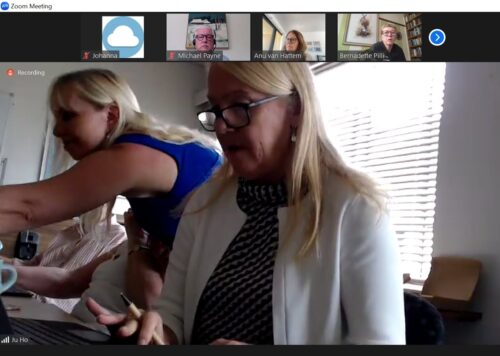
Following this insight, Kristi, along with Esmee Okamoto and Imbi Semmelweis, organised a workshop in November 2023. Facilitated by Mark Narustrang from Perth, the goal was to develop a business case and strategy to enhance media and communications for Estonian diaspora in Australia. You can read all about it here.
Left to right – Organising team: Esmee Okamoto, Kristi Barrow, Imbi Semmelweis. Workshop Facilitator: Mark Narustrang.
Now, we are thrilled to announce that we will be redeveloping eesti.org.au and forming a larger team to tackle how we do media and communications down under.
Over the next two weeks, we are actively seeking volunteers to join our Steering Committee and subcommittees to bring this Media Project to life.
We’re on the lookout for individuals with expertise in technology, content creation, marketing, and finance/funding.
Whether you’re an organiser, website developer, designer, writer, photographer, social media guru, fundraiser, or simply enthusiastic about all things Estonian in Australia – your unique talents are more than welcome.
If you’re connected to the pulse of your local city or group, we’re eager to hear from you too.
What matters most to us is not just your expertise, but your will and enthusiasm to make significant strides in our shared mission.
We want this Media Project to be a community-driven initiative. Your voice matters, and we want the new platform to be a reflection of our collective desires and aspirations.
We’re all volunteers here. Our community’s strength lies in our contributions; we get what we give. Help us shape the future of Estonian Australian connection.
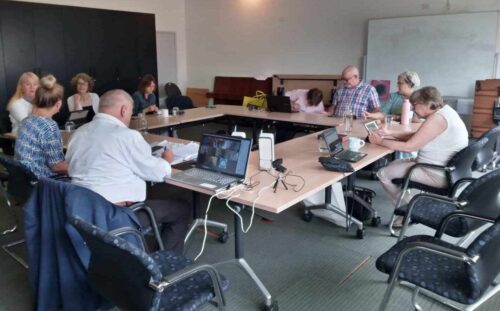
On Saturday the 11th of November 2023, people from all over Australia gathered at Sydney Estonian House to take part in the Australian Estonian Media Communications Workshop. The workshop was inspired by last year’s MEEDIARUUM 2022 in Tallinn, and was made possible by a grant from KÜSK and the Ministry of Foreign Affairs.
A critical component of maintaining and building any culture is a unified form of communication. Whether it’s communicating news, events, historical information or commentary, media channels are foundational to cultural connection. The workshop was the first step to formulate the new direction of Estonian-Australian media, under what’s now called the Media Project.
Participants came from all over Australia, including Perth and Darwin, over 3000 km from Sydney. To put this into perspective, this is about the same distance from Tallinn to Seville in Spain or Tallinn to Jordan!
“I was happy to lend my skills and knowledge as a digital journalist to this meeting of great minds.” – Silvi Vann-Wall
“This workshop signified an important milestone for Esto’s down under, emphasising our shared responsibility to preserve community today and build the bridges that connect us tomorrow.” – Johanna Rivers
Left to Right: Esmee Okamoto – Sydney, Matthew Bendt – Central Coast, Silvi Vann-Wall – Melbourne, Maarja-Liis Schmidt – Adelaide, Kristi Barrow – Sydney, Marin Hicks – Perth, Lachlan Bell – Sydney, Janeli Adermann – Canberra, Siiri Iismaa – Sydney, Elina Peedoson – Gold Coast, Grete Kasemets – Perth, Mark Narustrang – Perth, Johanna Rivers – Geelong, Michael Payne – Melbourne, Manfred Mletsin – Darwin, Imbi Semmelweis – Sydney, Vanessa Yasmine Birgitta Roosmets – Melbourne and Ave Nukki – Sydney
The Outcomes
The outcomes of the workshop crystallised the purpose of the Media Project: “To provide community information relevant to individuals or organisations in Australia that are interested in, or connected to, Estonia”. This purpose will serve as our guide, steering every action and decision the Media Project makes moving forward.
Now, with a clear purpose in mind, the pivotal question was raised: How do we transform this purpose into reality?
One significant solution that emerged from the workshop was the need for a new platform. So, an objective was born: to redevelop our eesti.org.au. During the workshop, participants engaged in brainstorming sessions to outline the necessary steps to achieve this objective. The strategic focuses for 2024 have been identified as:
Consolidation: A one-stop-shop will assist existing beneficiaries as well as heighten awareness
Content: Ensuring accurate and timely content which is fit for purpose. Primarily this is driven by protocol and resources.
Governance: Instituting an appropriate governance structure to ensure the platform sustainably achieves Purpose.
Buy-in: A critical mass of key users is required to create community benefit across all of Australia.
Funding: An upfront investment in development and marketing will assist with making subsequent activities less costly.
As we set sail into 2024, the Media Project is gearing up to make this happen. Join our newly launched Facebook page for the latest updates on our progress. Get in touch if you’re eager to get involved – we’re recruiting now!
Special thanks goes to Esmee Okamoto and Imbi Semmelweis for their help in organising and Mark Narustrang for facilitating the workshop.
“The Australian Estonian Media Communications Workshop today was a great start to get the various States motivated in improving communication. We can’t wait to get the ball rolling, lots of great ideas and talented people… let’s hope we can harness this energy” Esmee Okamoto.
Photo Gallery
Photos courtesy of Matt Bendt and Esmee Okamoto.
Next Steps
We are looking for volunteers who want to actively contribute to bettering media and communications among Australian Estonians. In particular, we are currently seeking to form our Steering Committee and sub-committees.
As Estonians around the world are gathering to cheer for their homeland and celebrate the country’s independence day on 24 February, it’s appropriate to recall how the independent country was born, the independence maintained, lost and restored again.