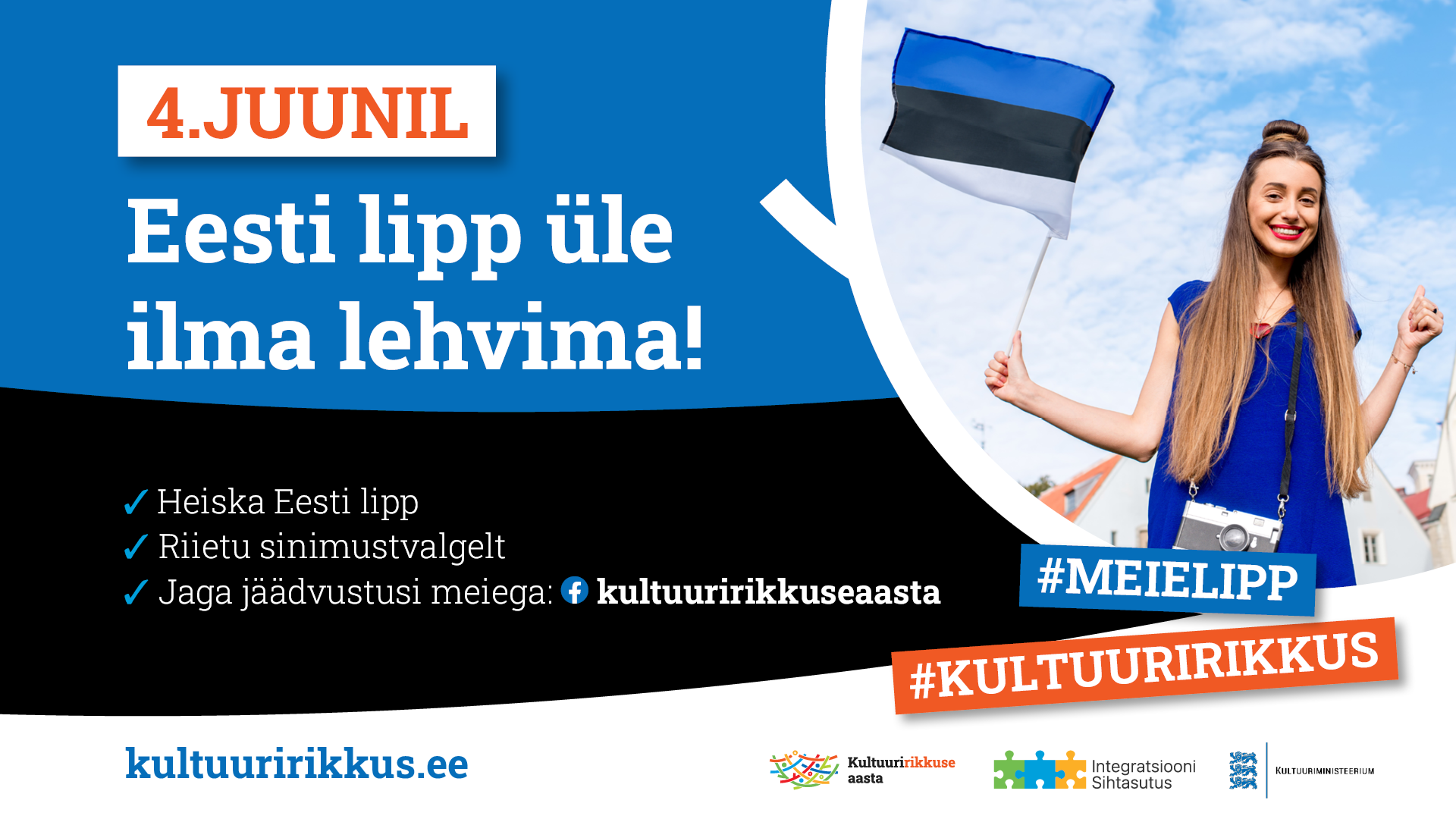
The Committee of the Year of Cultural Wealth invites you to celebrate the 140th anniversary of the Estonian flag. Let’s raise the flags and dress in blue and white! This is how we show that the Estonian flag unites everyone who loves Estonia.
We celebrate the anniversary of the Estonian flag both in Estonia and further afield on June 4. The Estonian flag symbolizes the values we share as Estonian people. Cultural richness is definitely among them – the diversity of Estonian communities and national cultures. That’s why we raise the Estonian flag together on this special day. (Read more about the Estonian Flag →)
On June 4, you can raise the colors of the Estonian flag high in two ways. First, we hoist blue and white in our home, office and everywhere else. Second, we can dress in the colors of the flag or add some blue and white details to our outfit.
In order for the flags raised in different ways to form the Estonian flag, which flies all over the world, the committee of the year of cultural wealth is waiting for pictures or videos of the flags. Post your flag pictures on Facebook using the hashtags #meielipp and #kultuuririkkus.
Share your snaps by June 4 📸
Post your flag photos and videos no later than the 4th. in June on Facebook, using the hashtags #meielipp and #kultuuririkkus.
Pictures and videos are welcome no later than June 4, but they can also be posted throughout the month of June. All posted images and videos will be gathered by the committee of the year of cultural wealth into a common Estonian flag.
The Year of Cultural Richness is a themed year that is being held this year under the leadership of the Ministry of Culture and the Integration Foundation with the aim of celebrating the diversity of the cultures of Estonian communities and peoples living in Estonia.
Let’s set the Estonian flags flying over the air! 💙🖤🤍
📣 We’re experimenting with a new news format for everything Estonian in Australia! You’ll find a summary of national and local community stories from this past month, as well as events coming up next month. What do you think? We’d love your feedback: contact us.
Have news or thoughts to share? Write to us: news [at] eesti.org.au
Key insights
This month, mother’s day was celebrated. Estonian Australians held events in Melbourne, Sydney, and Brisbane.
Eurovision 2024 was won by Switzerland, but Estonia’s Veisson dance won votes in Australia, with folk dance groups and individuals across the country coming together to film the dance in an impressive display of national cross-collaboration.
The Brisbane Estonian Society hosted Jaanituli – the epic midsummer party – with a bonfire, sauna and cold plunge, Estonian food and drinks, folk and fire dancing, and of course, lots of games.
AESL are collecting donations on behalf of Estonians in Australia, towards an Estonian Diaspora project to create a place of remembrance. Donate before July 31 to become an important part of this commemoration of our refugee forefathers.
EstWest revealed the winners of the EstWest Logo competition; congratulations go to Tiina Morton!
EstWest also uncovered a Meie Kodu newspaper clipping from 1966, highlighting the establishment of Eesti Maja (Eesti Tare) in Perth. They seek to re-establish an Eesti Maja and continue to build Estonian heritage in Western Australia.
May in NSW
The Sydney Eesti Selts invites you to join in two free kino! nights this June and July – the final two scheduled this year.
Lachlan Bell is on a mission to restore and revitalise the Estonian niche wall section at Rookwood Cemetery. Donations support the cause, and you are invited to join a working bee on Saturday, 15th June.
May in SA
The Consular Mission to Adelaide will take place on Monday, 10 June 2024. Book an appointment to apply for a new or renewal of an Estonian citizen’s Passport/ID-card.
May in VIC
On Sunday the 5th of May, the Melbourne Estonians celebrated Mother’s Day at Estonian House. Children performed Folk Dancing, and there were lots of games and activities for all, including card-making, baking, crafting wreaths, and some impromptu piano.
Please get in touch by emailing news [at] eesti.org.au
We are striving to improve communications among Estonian communities in Australia so that everybody can have the opportunity to share and hear about news and events.
Ultimately, the community gets what the community gives – we are humbly asking for your support. If there are events or news you know about, or have some thoughts or experiences you’d like to share, please reach out to us. Check out Submission Guidelines here or write to us at media [at] eesti.org.au with your questions or comments.
Follow us here or join our Facebook page for the latest updates on our Media Project.
The Australian Estonian Media Project (AEMP) held its second Steering Committee meeting this May 2024. The past month proved to be exciting, filled with progress and milestones.
One of AEMP’s standout achievements in May was the release of the Veisson Dance video – which was featured in the Global Estonian newsletter and even liked by Puuluup on Facebook. The video itself was fun, but the true triumph lay in the nation-wide collaboration that it took to make it happen. It showcased Australian Estonians’ willingness to say “YES” to a joint effort with a bit of fun, bringing us a step closer to unifying as the single, connected community of Estonians in Australia that we can all take pride in.
Another highlight includes the progress with AEMP’s partnerships. In collaboration with the Australian Council of Estonian Societies (AESL), the current AESL webpage was improved, content is being created in preparation for their new website (set for discussion later this year), and the Mass Flight campaign was launched – AEMP providing the landing page, donations tracking, and support with the collection and publication of personal stories related to the Mass Flight of 1944. This initiative has resulted in deeply moving submissions from you, Estonians in Australia, and praise from World Estonian Council for our collective results.
In collaboration with the Eesti Päevad (Estonian Festival) organising committee, the festival website was published in May. This site will serve as the home for Eesti Päevad, both this year and into the future, to promote upcoming festivals and preserve records of previous festivals. AEMP encourages anyone with photos, information, or stories from past festivals to get in touch and contribute to this evolving project. Development will continue throughout the year.
The AEMP also received positive news from the Estonian Ministry of Foreign Affairs and Integration Foundation: funding for the project has been approved! In their feedback, the Integration Foundation highlighted the necessity for a central media outlet for Estonians in Australia and expressed joy at seeing individuals across the country coming together to move step-by-step towards this goal.
Certainly, the ambition to improve media and connection among Estonians in Australia could not be possible without the desire to work together towards this vision. If you can get involved in the project – whether that is to share your wants and ideas, create content, help with marketing or anything else – write to: media@eesti.org.au. Building a stronger communal future is an incredibly valuable experience, and AEMP eagerly awaits you.
To top it all off, AEMP published 21 news posts this month – an average of over five posts per week! The comprehensive article about Puuluup & 5Miinust’s Eurovision entry set a new record with thousands of views. AEMP extends its heartfelt thanks to everyone who contributed – from individuals sharing their personal stories to societies sharing their good news and upcoming events, and the dedicated volunteers coordinating and publishing this all behind the scenes. These collective efforts inspire us all and highlight the joy of being part of the big and vibrant Estonian community in Australia.
Enn and Helmi Truupold (nee Kukk), presumably Tallinn ca 1930s.
We have been collecting stories about people who participated in the Mass Flight of 1944 as part of a campaign to support the Mass Flight memorial in Pärnu. Here we bring you the story of Rory Truupold.
My father was an Estonian refugee from the Second World War — and a mountain climber. I never understood the more profound implications of who he was and what he did when I was growing up, but in the last years of his life when he finally opened up about his family’s history, I finally understood why he was the way he was.
I did a few climbs with him at his indoor climbing gym in Sydney, and one day, I found myself at the top of the rather high climbing gym wall, having an epiphany about what makes my father tick. I discovered that to be a climber, you can only focus on your next move. You can’t look down or think about what you’ve left behind. The only thing that counts is what you do next. There’s no time to consider the past or look forward to the future. There’s only what you do next.
It makes sense now, although it didn’t when I was a kid, wanting a “normal” Dad at sports events cheering me on from the sidelines rather than the quiet man anonymously wandering around picking up other people’s rubbish. He was always content and supportive of what I was doing but remained unmoved by whether or not I was a winner or a loser. It also explains why you would never hear him say a bad word or critical remark about anyone, despite how deserving of scorn the rest of us may have thought they were. The only thing that ever seemed to matter was what you did next.
When I was in my early 20s, he explained, with some coaxing, that our original Estonian family name ‘Truupold’ had previously been a Germanic name ‘Treufeldt’ which translated in English to ‘Faithfield’ and may explain why many of my friends know me as Rory Faithfield.
He survived things that most of us will never have to face. His mother, my beautiful, brave, and pioneering Estonian Grandmother Helmi — a single mother at the time — fled south from their homeland in Tallinn as the Russian Red Army approached during the Second World War. They left on the night of Wednesday, 20 September, and the Red Army invaded Tallinn on Friday, 22 September 1944. My father was 16 years old.
As refugees living in Germany, they had several narrow escapes, miraculously boarding a train out of Dresden the night the British bombers came with their infamous firestorm. And, the day he went to the movies with his friend in the city of Ulm, 70 years ago, on the 17th of December 1944 — the day of its heaviest air raid.
He was a quiet, modest man who silently carried the scars, grief and knowledge of what happened to his Estonian family—both the ones who left and the ones who remained. He introduced me to the idea of doing things differently. Many kids I went to school with played rugby and cricket and went surfing. I played soccer and basketball and went skiing. He’d take us on annual family skiing holidays to the Snowy Mountains, where my parents first met on the slopes of Thredbo. He wouldn’t just take us on the usual adrenaline-inducing downhill skiing but preferred the solitary cross-country variety of exploration. He took us where no one could see whether you looked cool.
My father also introduced me to commitment — Living a life that showed me how to reach a little higher. He only ever said good things about others, which led me to conclude that it is impossible to fight the monster and not become it and that the only thing that matters is what you do next.
Initially written by Rory Truupold titled as “Eulogy – For My Father“’“; In Memory of Enn Truupold (23/6/1928 – 4/12/2014). EDITED & UPDATED 15 May 2024.
This story was collected as part of a campaign in support of the Mass Flight Memorial. If you have a story to share about your family’s mass flight experience, please write to us at news@eesti.org.au
The Estonian Cultural Foundation in Australia (ECFA) Ltd has as its objectives: • To promote literature, design, crafts, performing arts, radio, TV, moveable cultural heritage, music, community arts, video, visual arts, and film, which are of Estonian origin, in Australia; • To advance any purpose that are secondary or ancillary to the object in the above.
Expressions of Interest are now being sought from individuals and organisations who wish to apply for funding of projects which satisfy the objectives of the Foundation.
Total funding for these projects during the 2024-2025 financial year may be limited to approximately $20-30,000, subject to the discretion of the ECFA Ltd Board. Please note that all past recipients of funding from the ECFA will be required to make an application under this funding arrangement.
Individuals and organisations seeking funding should clearly outline the following matters in their application: 1. Name of individual and Organisation; 2. Contact details; also details for the project leader 3. A detailed description of the project proposal; 4. The total amount of funding being sought (applicants should note that funding is for the 2024-2025 financial year only – there is no guarantee that funding will be extended into subsequent years); 5. All applicants should submit a program of activities and a timetable for the implementation of the Project; 6. All applications are to be lodged in English.
• All successful applicants must submit a short article and photographs of the completed project that can be used for promotional purposes. • We also ask you to submit pictures from your project that can be used in promotional materials and the ECFA website. • All applicants will be required to submit a half-yearly progress report, due 1st November and 1st May including an Annual report which details the implementation and outcomes of their project; • The Annual report should also state whether the funding provided has been fully expended, and if there are some funds remaining, whether it will be refunded to ECFA, or a proposal submitted as to how these could be used for a purpose related to the project. • All applicants are also required to acknowledge the funding support on their web pages, Facebook, etc
A zoom meeting will be held at 08:00 p.m. on Tuesday 11th June 2024 where prospective applicants will be able to ask questions about the funding.
Please register your interest for this event online at ecfa.eesti.org.au/register or email to ecfa (a) eesti.org.au and we will send you the relevant details closer to the time.
Tere kino lovers! It has been a while since our last Sydney screening and we have two more planned movie nights at the moment with our first night to be held on the 2nd June and second on the 7th July.
In June, Kino is screening the short film Salme saladus / Another Dimension (2018) and Vee peal / On The Water(2020) looking at the chaotic lives lived behind the quiet facades of the village. This will currently be the penultimate planned Kino screening, with the next one planned on the 7th July.
Moonika Siimets’ short documentary Salme saladus / Another Dimension (2018) takes viewers to the small coastal borough of Salme in Saaremaa where modernity meets the past. Superstition and traditions are as common everyday phenomena as fishing and harvesting crops in Salme. We then follow the lives of the Sõnajalg family, an infamous 90s singing Christian quartet-turned business empire who fly helicopters and build wind farms. In a town where UFOs and spirits can be seen amongst Viking skeletons and the Sõnajalg dynasty’s wind turbines – there are two realities here that do not fit together. What on earth is going on there?
Our feature film for the night is Vee peal / On The Water (2020) directed by Peeter Simm. Selected as the Estonian entry for the Best International Feasture Film at the 94th Academy Awards, the comedic coming-of-age film takes us to the sleepy village set in the small southern city of Võru in 1982 where Andres is raised by his strict grandparents. Wanting to escape from the constant bullying at school, Andres takes to the nearby lake to fish beside colourful characters including convicted criminal Valter and the simpleminded fisherman Kolla. A dramedy full of oft-risqué humour comes as an adaptation of Olavi Ruitlane’s autobiographical novel of the same name – “Vii pääl” – released in 2015.
Wishing you all the best and see you there! You can watch the trailer for “Vee peal” on YouTube here!
EVENT DETAILS
Date: 2nd June, 2024 Admission: Free Doors open: 5:00pm Film starts: 5:30 pm 10-minute intermission: from 6:00 pm Language: Estonian with English subtitles Address:141 Campbell St, Surry Hills, NSW, 2010 Note: Parking is free on Sundays around Reservoir St, Samuel St and Goodchap Street
Kino! is kindly supported by Sydney Eesti Selts and the Estonian Cultural Foundation in Estonia (ECFA)
Saima's family in 1937, from Saima Riner's private collection.
We have been collecting stories about people who participated in the Mass Flight of 1944 as part of a campaign to support the Mass Flight memorial in Pärnu. Here we bring you the story of Saima Riner in English and Estonian.
In the Mass Flight of 1944, about 30,000 people escaped to Sweden and about 33,000 to Germany, according to the Estonian War Museum. The Estonian Archives in Australia (EAA) shares that about 6,000 Estonians ended up in Australia. EAA‘s digital exhibition raises the question – do you know how you ended up in Australia?
There are not so many among us anymore who can share their stories. Please reach out to them, so we can make our Australian collection of stories – 1944 to 2024. Below are some questions you can ask.
Milline oli elu Eestis, mis jäi maha? / What was life like in Estonia and what was left behind?
Kuidas läks põgenemine? / How did the escape go?
Kuidas algas uus elu Austraalias? / How did the new life in Australia begin?
On 5 May 2024, Sirje Jõgi-Rivers asked Saima Riner, aged 92, for her story.
Annual family photo, taken 28th May, 1943. Photograph by Kõdar Studio (Fotoateljee), Kõver street, Nõmme Estonia. Photo courtesy of Saima Riner.
Saima lived with her mother, father, and sister Maila in Nõmme, at 2 Metsa Street (previously Kahro House), where the Nõmme House Owners’ Bank, directed by her father Karl Aleksander Nõmmisto, was located.
Her mother, Emma Elisabeth, supported her husband’s social activities, such as the Children’s Protection Association and the Tennis Club.
Both parents were born in 1902 and were on the deportation list in 1940, but managed to escape deportation with the help of good people. On September 21, 1944, with the help of friends, the family made their way to Tallinn harbor, where they were allowed onto the last convoy of ships without written permits.
“Among the convoy was the ship Moero, marked with a red cross, which was torpedoed and sank within fifteen minutes. Also in the convoy was Lapland, an old cargo ship converted to transport people, from which we departed our homeland. The last image of the harbour, like a sea of fire, left the feeling that the whole of Tallinn was burning. When Moero sank, our Lapland also stopped to save whoever could be saved. As a 12-year-old girl, that image was very shocking to me, those poor half-drowned people, some so young…”
The ship reached Danzig, then under German occupation, from where we were sent by train to a transit camp near Berlin, then directed to where labor was needed. Our family was sent to Thuringia, near Jena, where my father was assigned to make optical lenses in a factory.
After the end of the war, when the division of lands came, Thuringia went to the Russians, and we had to flee again. This time we were helped by Americans with their large trucks and then by train in cattle wagons. Later, the DPs, displaced persons, were gathered into camps from where, about four years later, Western countries organised workforces for themselves.
Saima with her beloved dog Bella, who she had to leave behind during the mass flight of 1944. Photo courtesy of Saima Riner.
On April 3, 1949, the ship arrived in Australia at Fremantle, and on April 7, Melbourne. The Estonian Assistance Committee in Australia guaranteed that the family would not be a burden on the Australian state but would find work themselves, so they did not come with work contracts but with a “landing permit”.
In the premises of the Swedish Church in Melbourne, an Estonian congregation operated, pastor Stockholm invited the then 17-year-old Saima to the congregation. Saima became the church organist, a position she held for over 50 years. A new life in a new country had begun.
Today, Saima has two sons, four grandchildren, and two great-grandchildren in Australia. Her sister Maila has a total of 9 great-grandchildren. Their parents are buried in Falkner Cemetery.
In addition to the burning of Tallinn harbour and the rescue of the wounded from Moero at sea, the departure from her Nõmme home is forever on her mind – leaving behind her grandmother and dog Bella, as well as other relatives, and all the joys and sorrows of childhood with the Nõmme pine forest.
Saima Riner, aged 92, playing piano at Melbourne Estonian House on mothers day, May 2024. Photo courtesy of Kristel Alla.
Eesti keeles
Perefoto, 28. mail 1943. Foto Kõdar Fotoateljee, Kõver tn, Nõmme Eesti. Foto Saima Rineri erakogust.
Saima elas ema, isa, ja õe Mailaga Nõmmes, Metsa tanav 2, eelnevalt Kahro Majas, kuna samas asus Nõmme Majaomanike Pank mille direktor isa Karl Aleksander Nõmmisto oli.
Ema Emma Elisabeth kodune toetades abikaasa positsioonist tulenevaid seltskondlikke ettevõtmisi nagu Lastekaitse Ühing, Tennisklubi jne.
Mõlemad olid sündinud aastal 1902, olid aastal 1940 küüditamise nimekirjas kuid pääsesid heade inimeste abil küüditamise eest varjule. 21. Sept. 1944 sai perekond sõprade abiga Tallinna sadamasse, kus viimase konvoi laevadele inimesi lasti ilma kirjalike lubadeta.
“Selles konvois olid ka punaseristi laev Moero, mis tee peal torpeedoga hävitati ja mis põhja läks veerand tunni jooksul. Samuti oli konvois Lapland, vana kaubalaev ümber tehtud inimeste vedamiseks, kus ka meie oma sünnimaalt lahkusime. Viimane mälupilt sadama poole — see oli nagu tulemeri, jättis tunde, nagu terve Tallinn oleks põlenud. Kui Moero põhja läks, jäi ka meie Lapland seisma, et päästa keda veel päästa sai. See pilt minul kui 12 aastasel tüdrukul oli väga vapustav, need vaesed pool uppunud inimesed, mõned noorukesed….”
Laev jõudis Danzigi, tookordne sakslaste okupeeritud ala, kust meid rongiga edasi saadeti Berliini ligidale läbikäigu laagrisse, kust siis suunati sinna, kus tööjõudu vaja. Meie pere saadeti Thüringeni, Jena ligidal, kus isa vabrikus pikksilmaklaase määrati.
Pärast sõja lõppu kui maade jagamine tuli, sai Thüringen venelastele ja meie pidime uuesti põgenema. Seekord aitasid meid ameeriklased oma suurte veoautodega ja edasi rongiga loomavagunites. Siis koondati ka DP’d, displaced persons, laagritesse kust siis umbes neli aastat hiljem lääneriigid endale tööjõudu organiseeris.”
Saima oma koerake Bellaga, kelle ta pidi maha jätma 1944. aasta massipõgenemise ajal. Foto on Saima Rineri lahkel loal.
3. aprillil 1949 jõudis laev Austraaliasse Freemantle’sse ja 7. aprillil Melbourne’i. Eesti Abistamise Komitee Austraalias garanteeris et pere jai ja Austraalia riigile koormaks vaid leiab ise töö, nii ei tulnud mitte töölepinguga vaid perel oli “landing permit”.
Melbourne’i Rootsi Kiriku ruumides tegutses Eesti kogudus, mille pastor Stockholm soovis 17 aastane Saimat kogudusse. Saimast sai koguduse organist, mis ametit ta pidas üle 50 aastat. Uus elu uuel maal oli alanud.
Tänaseks on Saimal Austraalias kaks poega, neli lapselast ja kaks lapse-lapse- last. Õde Mailal on kokku 9 lapse-lapse- last. Vanemad on maetud Falkneri kalmistule.
Lisaks Tallinna sadama põlemisele ning Moero vigaste päästmisele merest, on silme ees alatiseks ka Nõmme kodust lahkumine – jäid maha vanaema ja koer, ning teisi sugulasi, ja kõik lapsepõlve rõõmud ja mured koos Nõmme männimetsaga.
92-aastane Saima Riner mängimas klaverit Melbourne’i Eesti Majas emadepäeval, mai 2024. Foto on Kristel Alla lahkel loal.
This story was collected as part of a campaign in support of the Mass Flight Memorial – a worldwide Estonian diaspora project. If you, or someone you know, have a story to share about the mass flight experience, please write to us at news@eesti.org.au
Each year Estonians, Latvians and Lithuanians commemorate the 14th of June, 1941 mass deportations from the three Baltic States. For the Baltic States that historical event has again become acutely relevant since Russia’s invasion of Ukraine in 2022 and we feel deeply Ukraine’s suffering.
Sydney
83rd anniversary of mass deportations from the Baltic State by Soviet Union occupying forces 1941
Speakers from the Latvian, Lithuanian, Estonian and Ukraine communities
Performances by
the Melbourne Latvian choir Daina, male choir Veseris and youth choir Ausma
Lithuanian mixed choir Dainos Samburis, and
the Estonian Women’s Choir, Kodu
Entry by donation
Organised by the Association of Latvian Organisations in Melbourne, with the Australian Lithuanian Community in Melbourne and the Estonian Society of Melbourne.
The Council of Estonian Societies in Australia (AESL) is an umbrella organisation that unites around 20 Estonian organisations all over Australia, belonging to the Estonian World Organisation.
At the last meeting, the AESL Board decided to support the establishment of the Mass Flight monument in Pärnu. Since then, Juho has written an introduction about the monument plan and started collecting donations in Australia. In the May board meeting, we discussed the next steps and what else we can do to keep the donations coming.
Sirje reiterated the need to publish a series of articles: if we all find a person whose childhood was in Estonia before the 1944 escape and ended up in Australia, then interview and publish these stories, this catches two birds – it increases donations for the monument and provides value to us as such stories are timeless. The AESL Board agreed to this action.
Additionally, this initiative is not only for AESL to write the stories, but is an open invitation for everyone across Australia to find someone in their circle who could share their escape story.
The second topic covered was children’s camps. AESL has supported the camp at Sõrve for many years, which is considered the most significant enterprise for our youth in Australia. In recent years, there has been a wonderful revival and enthusiasm for organising camps in other cities. Marin reported that Perth is in the process of organising its own kids camp, and Ingrid reported the same for Melbourne. The Board decided to support these developments and include funding for all ongoing camps in next year’s budget. It was also discussed that sometimes it is complicated for applicants to be aware under which organisation to put the application in; AESL is able to coordinate on behalf of the applicant.
Third theme related to AESL’s media presence. Ongoing work includes: Mission Statement (Juho), Constitution (Juho), AGM Wrap (Juho), Annual Booklets (Siiri); followed by explanatory articles about AESL initiatives, including the Eesti Päevad Festival (Sirje), Sõrve Camp (Siiri), Estonian Media in Australia (Siiri), and Language Teaching (Sirje).
Once the material is written and collected, we will approach the Australian Estonian Media Project for help to set AESL up under eesti.org.au.
5 years, 37 countries, and 125 cities – The award-winning TV presenter-journalist Roald Johannson has circumnavigated the world for his show, “Roaldi retked”.
Kui üks Eesti tuntumaid naistrummareid Helena Victoria Kirss kolis seitse aastat tagasi ootamatult Austraaliasse, said Eesti kontserdikorraldajad tõelise šoki! Kuidas küll julges andekas muusik lahkuda kodumaalt oma populaarsuse tipul, kui saalid olid rahvast täis ja esinemisgraafik ülitihe? Roald Johannson suundub Austraalia idarannikule ning leiab eest topeltkodakondsusega eestlanna, kes üritab kaugel kängurumaal muusikalist läbilööki ning punub koos elukaaslase Tõnniga ühist pesa maalilisel Tamborine’i mäel!
Watch the funny and substantive history programme Eesti (täielik ja kontrollitud) ajalugu– “The (Complete and Verified) History of Estonia” – which takes people on a journey through Estonia’s history.
Language: Estonian Subtitles are available in Estonian.
Series description:
Kes olid esimesed inimesed Eestimaal? Kust ja millal nad siia tulid, mida siin tegid, uskusid, sõid ja jõid? Algab Andrus Vaariku retk läbi Eesti ajaloo.
Sarja stsenarist on Tauno Vahter, režissöör Raivo Maripuu, toimetaja Kai Väärtnõu ning kunstnik Siiri Taimla-Rannala.
A huge thank you to all the wonderful people who took the time to cast their votes. With over 700 participants, your support and engagement have been invaluable.
If it weren’t for your invaluable input, we’d still be wondering which logo truly captures the essence of EstWest among the incredible choices we had available.
Tiina Morton’s logo claimed the top spot with the highest number of votes.
Triinu Pankratov secured the second-place position.
And the fortunate recipient of the third-place position is Paul Kadak!
We truly value the importance of a logo in representing our identity. It’s not just a symbol; it’s the face of EstWest, embodying our values, vision, and identity.
🌟 That’s why we’re immensely grateful to all the participants who invested their time and talent in creating their logo submissions. A massive thank you to each and every one of you! 🌟
We’re thrilled to start using the logo and can’t wait to send our
Estonian-themed hampers to the TOP 3 logo authors.